1.80 vs 2 Carat Diamonds: Is the Size Difference Noticeable?
July 24, 2026
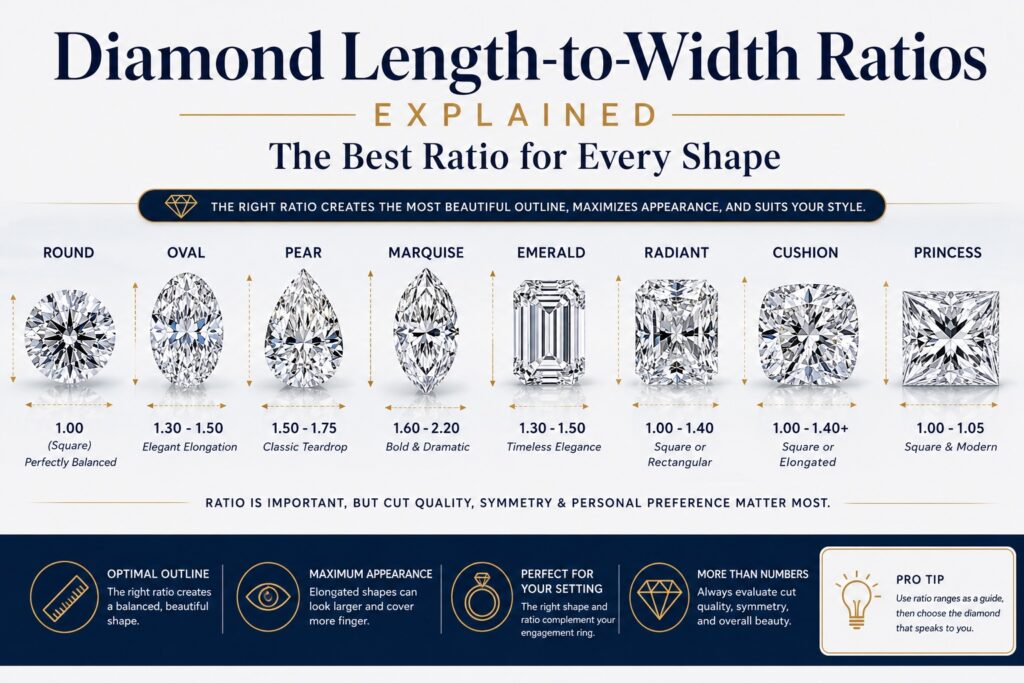
Diamond Length-to-Width Ratios Explained: The Best Ratio for Every Shape
August 14, 2026Lab-Grown Diamond Color Grades: D vs E vs F Compared
When shopping for a high-quality lab-grown diamond, you will frequently encounter three color grades at the top of the scale: D, E and F.
All three traditionally sit within the colorless range, and the visual differences between them can be extremely subtle. That raises an obvious question: is it worth paying more for a D color lab-grown diamond, or will an E or F look essentially the same once it is set in an engagement ring?
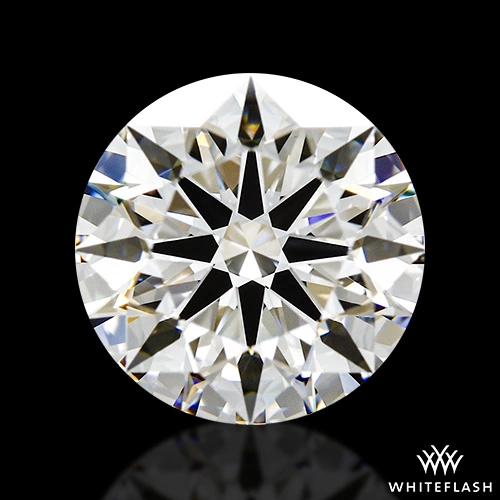
1.01 ct D VVS1 Round Cut Precision Lab Grown Diamond from Whiteflash
For most buyers, F color offers everything they could reasonably want from a colorless lab-grown diamond, while E offers an excellent middle ground. However, lab-grown diamond pricing is very different from natural diamond pricing, and the premium for moving to D can sometimes be surprisingly small. When that happens, there is little reason not to consider the higher grade.
There is also more to evaluate than the letter on the grading report. Cut quality, transparency, growth characteristics and unusual color nuances can all affect how beautiful a lab-grown diamond actually looks.
In this guide, I will compare D vs E vs F lab-grown diamonds, explain whether you can see a difference, and show you where I recommend shopping.
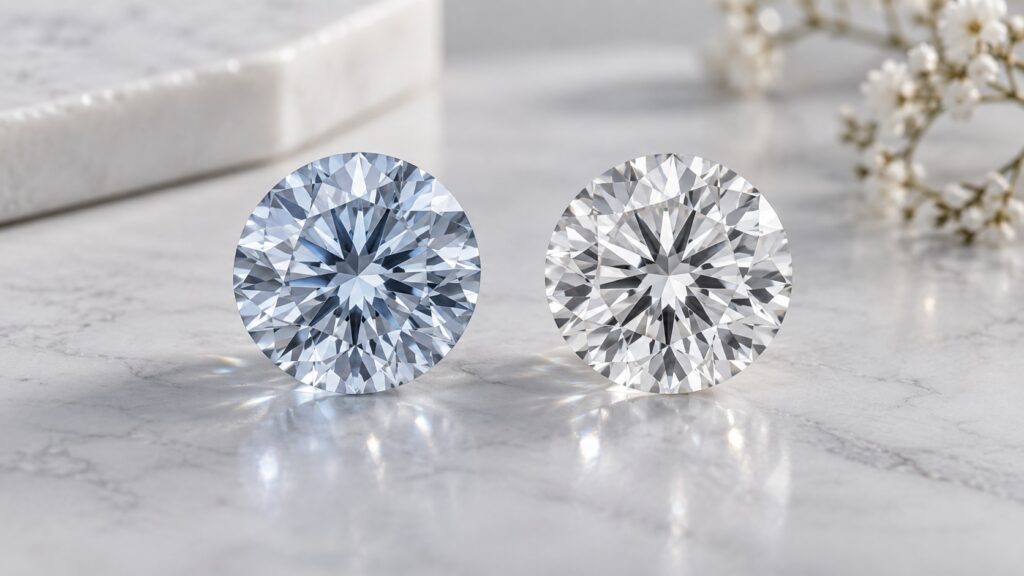
D vs E vs F Lab-Grown Diamonds: Quick Comparison
Under the traditional D-to-Z diamond color scale used by laboratories such as IGI, D, E and F all fall within the colorless category. IGI describes the differences between these grades as extremely small, with D representing the absence of detectable color and E and F showing only minute differences under controlled grading conditions.
| Grade | Color Category | What You Can Expect | My View |
|---|---|---|---|
| D | Colorless | Highest traditional color grade | Best if the price premium is minimal |
| E | Colorless | Virtually colorless to most observers | Excellent combination of quality and price |
| F | Colorless | Still firmly within the colorless range | Best value for most buyers |
The important point is that moving from F to E to D does not produce progressively more sparkle.
That comes primarily from cut quality and light performance. You can learn more in my complete diamond cut guide.
A beautifully cut F color diamond can be far more impressive than an average D color diamond.
My Top Choice for Premium Lab-Grown Diamonds
If cut quality is the priority, start with Whiteflash Precision Lab diamonds. Their Precision Lab category focuses on precision-cut lab-grown diamonds with extensive light-performance information, making it much easier to evaluate more than just the color grade. You can also read my full Whiteflash review.
An Important Change to Lab-Grown Diamond Grading in 2026
Before comparing D, E and F, there is an important update buyers need to understand.
In October 2025, GIA changed the way it assesses newly submitted D-to-Z laboratory-grown diamonds.
Rather than continuing to use the traditional individual color and clarity grades developed for natural diamonds, GIA introduced two broader laboratory-grown quality categories: Premium and Standard.
Under GIA's current system:
-
A Premium laboratory-grown diamond must meet criteria that include D color, VVS clarity or higher, and Excellent polish and symmetry. Round brilliants must also achieve an Excellent cut grade.
-
The Standard category permits a wider range of characteristics, including E through J color and VS clarity, provided other minimum quality requirements are met.
This means you may now encounter two different types of grading information when shopping for a lab-grown diamond.
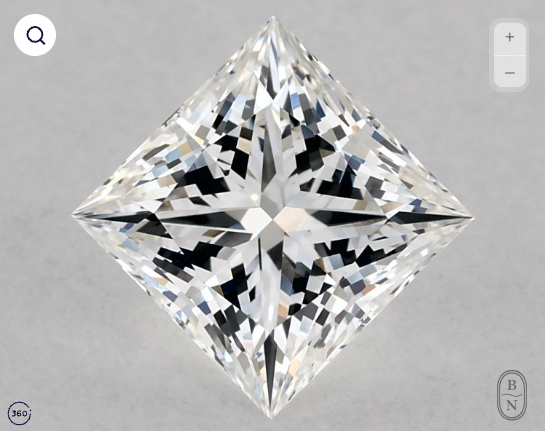
IGI 1.52 Carat Princess Lab-Grown Diamond from Blue Nile
IGI reports still commonly show traditional grades such as D, E, F, VS1 and VVS2, while newer GIA laboratory-grown assessments may instead describe the diamond as Premium or Standard. IGI continues to evaluate lab-grown diamonds using the D-to-Z color range.
For a deeper look at grading laboratories, read my diamond certification guide and dedicated IGI certification guide.
How Is Lab-Grown Diamond Color Graded?
Color grading measures the absence of body color in a white diamond.
With the traditional D-to-Z system, D is the highest grade, followed by E, F, G and so on.
IGI grades diamond color in a standardized viewing environment. Diamonds are assessed upside down and through the side, rather than simply being judged face-up as you would normally see them in jewelry. Multiple graders contribute to the final assessment.
The scale is traditionally grouped as follows:
-
D-F: Colorless
-
G-J: Near colorless
-
K-M: Slightly tinted
-
Lower grades: Increasingly noticeable body color
You can explore the entire scale in my diamond color guide.
That grading environment is important because the differences between D, E and F are often much easier for trained gemologists to identify under controlled comparison than for a consumer looking at one mounted diamond on a hand.
What Is a D Color Lab-Grown Diamond?
A D color diamond sits at the very top of the traditional color grading scale.
There is no higher standard D-to-Z color grade.
A high-quality D lab-grown diamond should present an extremely crisp, colorless appearance, making it an obvious choice for someone who wants the highest specifications possible.
You can read my full D color diamond guide for more information.
Advantages of D Color Lab-Grown Diamonds
D color makes sense if:
-
You want the highest traditional color grade available.
-
You are particularly sensitive to warmth in diamonds.
-
You are choosing a large stone where subtle differences can become easier to detect.
-
You want an icy-white appearance in platinum or white gold.
-
The price difference between D and E or F is negligible.
-
You simply like knowing you purchased the highest color grade.
The final point should not be dismissed. Engagement rings are emotional purchases, and if owning a D color diamond matters to you, the lower cost of lab-grown diamonds can make that specification far more accessible than it would be with a natural diamond.
Is D Color Worth Paying More For?
Not always.
A D color grade does not automatically make one diamond more beautiful than an F color diamond.
If choosing D forces you to compromise on diamond cut quality, I would choose the better-cut F every time.
However, lab-grown pricing can compress the difference between color grades. Current retail inventories can contain D, E and F diamonds with surprisingly small price differences when carat, clarity and cut specifications are similar. Blue Nile's current lab-grown inventory, for example, shows D, E and F stones sitting very close together at some comparable weights and grades.
That changes the buying calculation.
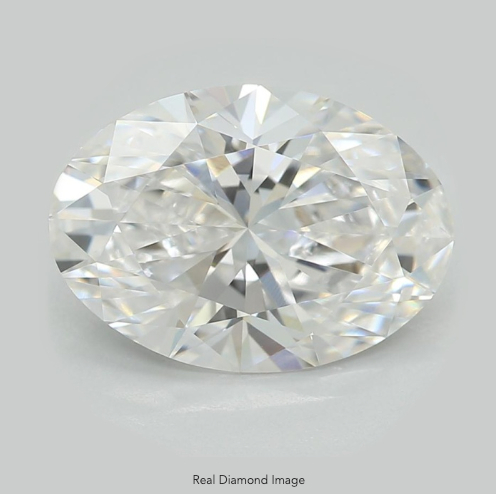
2.09 Carat Oval Lab Grown Diamond Super Ideal Cut • D Color • VVS2 Clarity • GIA
With natural diamonds, dropping from D to F can potentially create meaningful savings. With lab-grown diamonds, I would always check the actual price difference before automatically dropping the color grade.
What Is an E Color Lab-Grown Diamond?
E is the second-highest grade on the traditional diamond color scale.
It remains completely within the colorless range, sitting between D and F.
Read my complete E color diamond guide for more detail.
To most people, a well-cut E diamond will look exceptionally white. Distinguishing an E from a D without comparison stones and controlled lighting can be extremely difficult.
Why Choose E?
E is an attractive choice if you want:
-
An unquestionably high color grade
-
An icy appearance
-
A potential saving compared with D
-
Excellent suitability for platinum or white gold
-
A sensible specification for larger lab-grown diamonds
If I found two otherwise comparable diamonds and the E offered better cut quality, optical performance or transparency than the D, I would not hesitate to choose the E.
The difference on the grading report is far more obvious than the difference you are likely to see on the hand.
What Is an F Color Lab-Grown Diamond?
F is the lowest grade within the traditional D-F colorless range, but describing it as the "lowest" can give entirely the wrong impression.
An F color diamond is still an exceptionally white diamond.
IGI classifies D through F as colorless and notes that the nuances separating these upper grades are very subtle.
You can learn more in my dedicated F color diamond guide.
Why I Often Recommend F Color
For most buyers, F is where I would begin.
You receive:
-
A genuinely colorless grade
-
Excellent compatibility with platinum and white gold
-
Little risk of obvious yellow or brown warmth from the traditional color grade itself
-
The opportunity to put more of the budget toward cut, carat weight or the setting
With natural diamonds, the financial argument for F can be significant.
With lab-grown diamonds, you need to be slightly more flexible because moving to E or even D may cost relatively little. For that reason, I would treat F as the minimum target rather than automatically assuming it is the final choice.
Search F, E and D together and compare the actual diamonds.
Can You See the Difference Between D, E and F Lab Diamonds?
In normal jewelry viewing, usually not easily.
Remember that professional color grading is performed under controlled conditions designed specifically to reveal subtle color differences. IGI evaluates diamonds loose, upside down and from the side in a standardized environment.
That is very different from looking at a diamond:
-
Face-up
-
Set into an engagement ring
-
Surrounded by reflected light
-
Viewed while moving
-
At normal conversational distance
Cut diamonds are designed to return and disperse light. In a well-cut round brilliant, that light performance can make extremely subtle differences between neighboring color grades even harder to appreciate during everyday wear.
If you placed a D and F of identical size, cut and clarity next to each other under neutral lighting, a trained observer might identify a subtle difference.
Show those same stones independently once mounted and the distinction becomes far less obvious.
Does Diamond Size Make Color More Noticeable?
It can.
As carat weight increases, there is simply more diamond material for you to observe.
This means I give color slightly more consideration with very large lab-grown diamonds than I do with smaller stones.
That matters because lab-grown diamonds have made 2, 3 and even 4 carat center stones accessible to far more buyers.
For a 1 carat round, I would have very little hesitation about an F color stone with excellent optical performance.
At 3 or 4 carats, I would still consider F, but I would inspect high-resolution images and videos carefully and compare it with E and D alternatives.
Does Diamond Shape Affect How Color Appears?
Yes.
Different shapes can retain and display body color differently.
Round Brilliant
Round diamonds are extremely efficient at returning light when properly cut, making them relatively forgiving of small differences in color.
F is an easy recommendation here.
Oval, Pear and Marquise
Elongated brilliant cuts can sometimes concentrate color toward their pointed ends or tips.
I would inspect these shapes carefully rather than relying only on the laboratory grade.
Emerald and Asscher
Step cuts create broad flashes of light instead of the intense scintillation seen in a round brilliant.
Their large, open facet structure can make body color and transparency easier to appreciate, particularly in larger diamonds.
E or D may therefore appeal more to buyers who want a very crisp emerald or Asscher cut, although a beautiful F can still be an excellent choice.
D vs E vs F in White Gold and Platinum
Platinum and white gold provide a bright, neutral-colored backdrop around the diamond.
All three grades work exceptionally well.
If you want the coldest, iciest overall aesthetic, D is technically the highest grade, but E and F remain colorless grades and can look extremely similar once mounted.
I would put more emphasis on the quality of the actual diamond than on chasing D simply because the ring is platinum.
D vs E vs F in Yellow or Rose Gold
Yellow and rose gold introduce warmth from the setting itself.
That makes the difference between D, E and F even less important in many designs.
If the prongs or bezel holding the diamond are also yellow or rose gold, some of the surrounding metal color can influence how the stone appears.
Spending heavily to move from F to D can therefore have very little practical benefit.
If the ring uses a yellow or rose gold shank with white metal prongs, you still get the contrast of a bright white center diamond while keeping the warmth of the band.
Lab-Grown Diamond Color Is About More Than D, E or F
This is one of the most important parts of buying a lab-grown diamond.
Do not assume two F color lab diamonds will necessarily have exactly the same appearance.
Lab-grown diamonds can be produced using two principal methods:
-
HPHT, or High Pressure High Temperature
-
CVD, or Chemical Vapor Deposition
Growth conditions can introduce characteristics that are not fully communicated by simply reading D, E or F on a certificate.
GIA research has documented that earlier HPHT laboratory-grown diamonds could exhibit yellow-orange color related to nitrogen or blue color associated with boron. Modern production has improved substantially, and GIA reports that colorless material now represents the vast majority of the HPHT lab-grown diamonds it receives.
This is why I recommend evaluating:
-
High-resolution video
-
Body color
-
Transparency
-
Any unusual blue, gray or brown appearance
-
Growth-related strain or graining
-
Cut quality
-
Light-performance imagery where available
A technically high color grade is not an excuse to skip visual inspection.
Color vs Cut: Where Should You Spend Your Money?
Cut wins.
If you have a choice between:
Diamond A: D color, average cut quality
and
Diamond B: F color, exceptional cut and light performance
I would take Diamond B.
Cut governs how effectively the diamond handles light, influencing brilliance, fire and scintillation. My diamond cut guide explains this in much greater detail.
The difference between an outstanding and mediocre cut can be immediately visible.
The difference between D and F often is not.
This is also why I particularly like retailers that provide diagnostic imaging rather than expecting customers to buy from a certificate alone.
What Clarity Should You Pair With D, E or F?
There is little benefit in buying a D color diamond and automatically combining it with flawless clarity.
Color and clarity are separate characteristics.
For most buyers, a properly selected VS1 or VS2 lab-grown diamond provides more than enough clarity. VVS grades can also be attractive because the lab-grown price structure sometimes makes stepping up relatively inexpensive.
Read my full diamond clarity guide before deciding how high you need to go.
Again, compare individual stones.
I would rather own a beautifully transparent F VS1 with exceptional cut than a D IF diamond with inferior optical performance.
Compare the Market Before Buying
For a very broad selection, Blue Nile's lab-grown diamond inventory makes it easy to compare D, E and F diamonds across different carat weights and clarity grades. You can read my complete Blue Nile review before purchasing. Blue Nile currently lists lab-grown diamonds with independent grading reports, including IGI-graded stones.
What Certification Should a Lab-Grown Diamond Have?
Independent grading is essential because the certificate tells you what you are actually comparing.
For lab-grown diamonds, IGI is particularly important because it continues to provide the traditional D-to-Z color grades that shoppers are familiar with. Its lab-grown reports identify the diamond as laboratory grown and assess characteristics including color and clarity under standardized conditions.
You can learn more in my IGI certification guide.
GIA remains one of the world's most important gemological institutions, but remember that its current lab-grown assessment system is different. New submissions are categorized as Premium or Standard rather than receiving the same individual D-to-Z and clarity nomenclature previously used.
You may still encounter older GIA lab-grown reports using the previous grading format, so always check the report itself rather than making assumptions.
Where to Buy D, E and F Lab-Grown Diamonds
I recommend starting with three retailers, each for a slightly different reason.
1. Whiteflash Precision Lab: Best for Cut Quality
My first choice for buyers who prioritize diamond performance is Whiteflash Precision Lab.
The difference here is the emphasis on cut precision and supporting optical information.
Whiteflash's Precision Lab category is built around carefully selected precision-cut lab-grown diamonds. Its round Precision Lab diamonds are presented with extensive diagnostics that can include ASET, Ideal-Scope, Hearts and Arrows imagery and HD video, giving you far more information than a basic grading report alone.
Current Precision Lab inventory focuses on high color and clarity grades, including D, E and F options.
This is particularly useful for the subject of this guide.
Once you are already shopping within the D-F colorless range, cut quality becomes far more important than squeezing out another single color grade.
My approach would therefore be to find the best-performing diamond first and then compare whether D, E or F represents the best overall package.
Read my complete Whiteflash review for a detailed look at the retailer.
2. Blue Nile: Best for a Large Selection
Blue Nile is a strong choice if you want to compare a very large number of lab-grown diamonds.
Its search currently allows shoppers to filter lab-grown diamonds by D through J color as well as carat, clarity, cut and shape, making it straightforward to compare similar D, E and F stones.
This is exactly how I recommend shopping.
Instead of deciding in advance that you must have an E color diamond, run the same search across D, E and F.
You may discover that:
-
A D costs almost the same as an E.
-
An F lets you increase carat weight.
-
One E has significantly better proportions than surrounding options.
-
The best overall diamond is not the one with the highest color grade.
Blue Nile's breadth of inventory makes those comparisons easier.
Read my Blue Nile review before purchasing.
3. Brilliant Earth: Best for Selection and Setting Choice
Brilliant Earth is another option worth considering for lab-grown diamonds, particularly if you also want a broad range of engagement ring designs.
The retailer offers lab-grown diamonds across multiple shapes and grades and provides diamonds evaluated by independent grading laboratories including GIA, IGI and GCAL.
That makes it possible to compare different colorless options while also considering how each will look in your preferred setting.
If you are choosing between D, E and F, pay attention to both the grading report and the diamond's actual imagery rather than filtering by color alone.
You can read my full Brilliant Earth review before shopping.
Whiteflash vs Blue Nile vs Brilliant Earth for Lab-Grown Diamonds
| Retailer | Best For | Why Consider Them |
|---|---|---|
| Whiteflash Precision Lab | Cut quality and diagnostics | Precision-focused inventory with extensive light-performance information |
| Blue Nile | Selection | Large inventory makes D, E and F comparison easy |
| Brilliant Earth | Settings and variety | Broad lab-grown selection and extensive engagement ring designs |
For more recommendations, see my guide to the best places to buy lab-grown diamonds.
So, Should You Buy D, E or F?
For most people, my recommendations are straightforward.
Choose D If:
-
You want the highest possible traditional color grade.
-
The price difference compared with E and F is very small.
-
You are buying a particularly large diamond.
-
You are highly sensitive to diamond color.
-
Having the highest specification matters to you personally.
Choose E If:
-
You want an extremely high color grade without automatically paying for D.
-
The E diamond has better cut or optical characteristics than comparable D stones.
-
You want a very crisp appearance in platinum or white gold.
-
It offers the strongest overall combination of specifications.
Choose F If:
-
You want the best starting point for value.
-
You would rather prioritize cut quality or carat weight.
-
You want a genuinely colorless diamond.
-
You cannot see a meaningful difference between the available F, E and D options.
For most buyers, I would start at F and search upward rather than starting at D and working downward.
That lets you see whether E or D genuinely adds much to the price.
With today's lab-grown market, you may be pleasantly surprised.
My Ideal Lab-Grown Diamond Search
If I were buying a round lab-grown engagement ring today, my initial filters would look something like this:
Color: D-F
Clarity: VS1-VVS2
Cut: Prioritize the very best available
Certification: IGI or another respected independent laboratory
Polish: Excellent
Symmetry: Excellent
Carat: Based on budget and preferred appearance
I would then narrow the candidates by looking at:
-
Cut proportions
-
Light performance
-
High-resolution video
-
Transparency
-
Any unusual body color or nuance
-
Price
-
Color grade
Notice where color sits on that list.
Once you are already comparing D, E and F, the difference between the letters should rarely be the deciding factor.
Frequently Asked Questions
Is D Better Than E in a Lab-Grown Diamond?
D is technically the higher traditional color grade, but that does not necessarily mean it will be the more beautiful diamond.
If the E has superior cut quality, I would choose the E.
Is E or F Better for a Lab-Grown Diamond?
E is one grade higher, but both belong to the traditional colorless range.
F will generally be sufficient for someone who simply wants a bright white diamond. E can be worthwhile when the additional cost is small.
Is F Color Too Yellow for a Lab-Grown Diamond?
No.
F belongs to the D-F colorless category under the traditional IGI grading scale.
If an F lab-grown diamond displays an unusual tint or nuance, that is a reason to inspect the specific stone carefully rather than concluding that all F diamonds are warm.
Can You Tell D From F With the Naked Eye?
It can be extremely difficult, particularly when the diamonds are viewed separately and face-up.
The grading difference is real, but it is deliberately measured under controlled laboratory conditions.
Does D Color Sparkle More Than F?
No.
Color and cut are different characteristics.
Sparkle depends primarily on the diamond's cut quality and how effectively its facets return and disperse light.
Is It Worth Buying D Color Because Lab Diamonds Are Cheaper?
Sometimes.
This is one of the strongest arguments for D lab-grown diamonds.
If upgrading from F to D adds very little to the overall price, you may decide there is no reason not to take the higher grade.
Just do not sacrifice cut quality to get it.
Final Verdict: D vs E vs F Lab-Grown Diamonds
D, E and F are all exceptional color grades.
If this were a natural diamond comparison, the potential price differences between the three grades would play a major role in my recommendation.
With lab-grown diamonds, the decision is slightly different.
Prices can sit close enough together that D may occasionally represent excellent value, despite being the highest traditional color grade. That is why I recommend searching all three simultaneously.
For most buyers:
F is the value choice.
E is the excellent middle ground.
D is worth considering when the premium is small.
But none of those letters should take priority over the quality of the actual diamond.
I would much rather buy an exceptional F color diamond with outstanding cut, transparency and light performance than a mediocre D simply because it has the highest color grade.
For buyers focused on cut quality, my first choice is Whiteflash Precision Lab, with more details available in my Whiteflash review.
For a much broader inventory to compare, Blue Nile is worth exploring alongside my Blue Nile review.
Finally, buyers who want to compare lab-grown diamonds alongside a broad selection of engagement ring designs should consider Brilliant Earth and read my complete Brilliant Earth review.
Whichever grade you choose, remember the central point: D, E and F are all colorless grades. Buy the best diamond, not simply the highest letter on the certificate.
Jasmine, together with Benjamin (Ben), is the passionate force behind The Diamond Genie. Their journey into the world of diamonds began with their own engagement ring experience, sparking a deep fascination with gemology and the diamond trade. This personal adventure turned into a mission to empower others in their diamond buying decisions. Jasmine’s expertise, honed from extensive study and immersion in the field, drives The Diamond Genie’s commitment to helping customers find the best diamonds for the best value. With a keen eye for quality and value, and a desire to share knowledge with others who might feel overwhelmed by the diamond selection process, Jasmine has made The Diamond Genie a trusted ally for anyone navigating the complexities of diamond purchasing.