Can a Diamond Be Too Deep? Depth Percentage and Face-Up Size Explained
September 21, 2026
Prong vs Bezel Engagement Ring Settings: Which Is Better?
October 29, 2026The jump from a 1 carat diamond to a 2 carat diamond sounds straightforward.
A 2 carat diamond weighs twice as much, so you might expect it to look twice as large and cost roughly twice as much.
Neither is true.
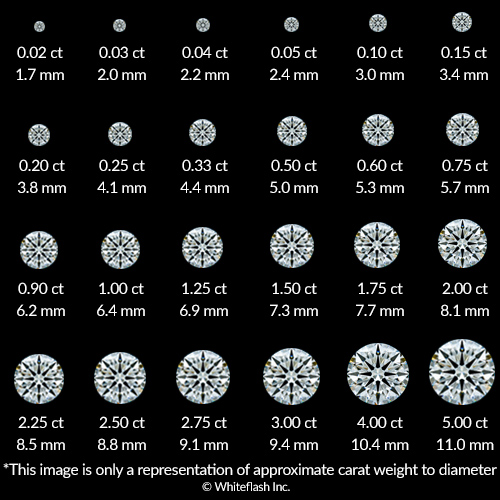
A well-cut 2 carat round diamond is noticeably larger than a 1 carat round, but its face-up diameter increases by only around 25%. At the same time, a high-quality natural 2 carat diamond can cost considerably more than twice the price of an equivalent 1 carat stone.
That creates an important question:
Is moving from 1 to 2 carats actually worth the money?
For buyers who want obvious visual impact and have the budget, 2 carats is a substantial upgrade. But if value matters more, a beautifully cut 1 carat diamond can be the smarter purchase.
1 vs 2 Carat Diamonds at a Glance
| 1 Carat Diamond | 2 Carat Diamond | |
|---|---|---|
| Weight | 1.00 ct | 2.00 ct |
| Typical round diameter | Around 6.4 to 6.5 mm | Around 8.0 to 8.2 mm |
| Visual difference | Substantial | Significantly larger |
| Price | More accessible | Considerably higher |
| Color sensitivity | Moderate | Greater |
| Inclusions easier to see? | Less so | Potentially |
| Best for | Value and versatility | Maximum visual impact |
These dimensions are approximate.
Actual face-up size depends heavily on the diamond's cut, depth, girdle and overall proportions.
That is why carat weight should never be assessed in isolation.
How Much Bigger Does a 2 Carat Diamond Look?
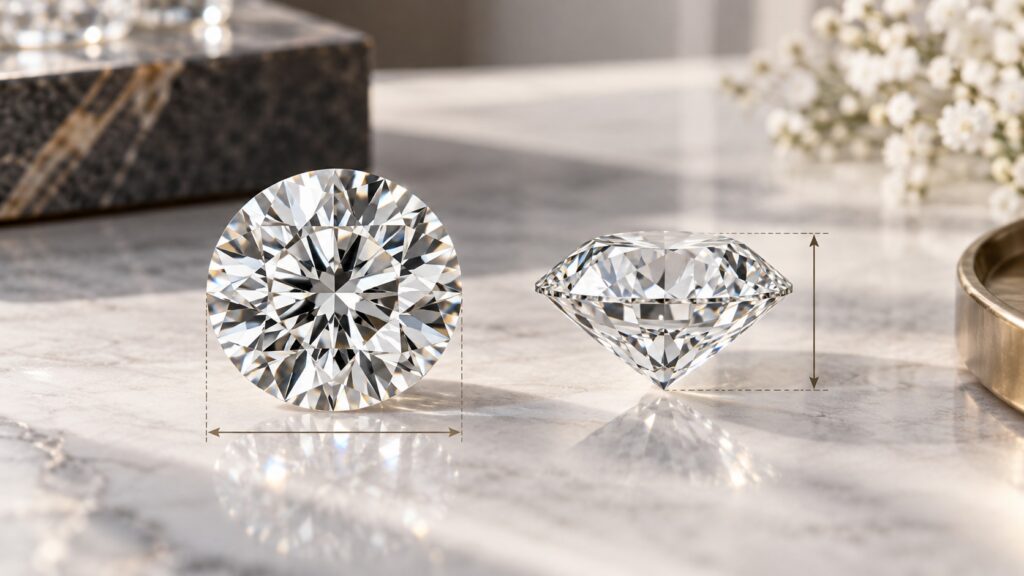
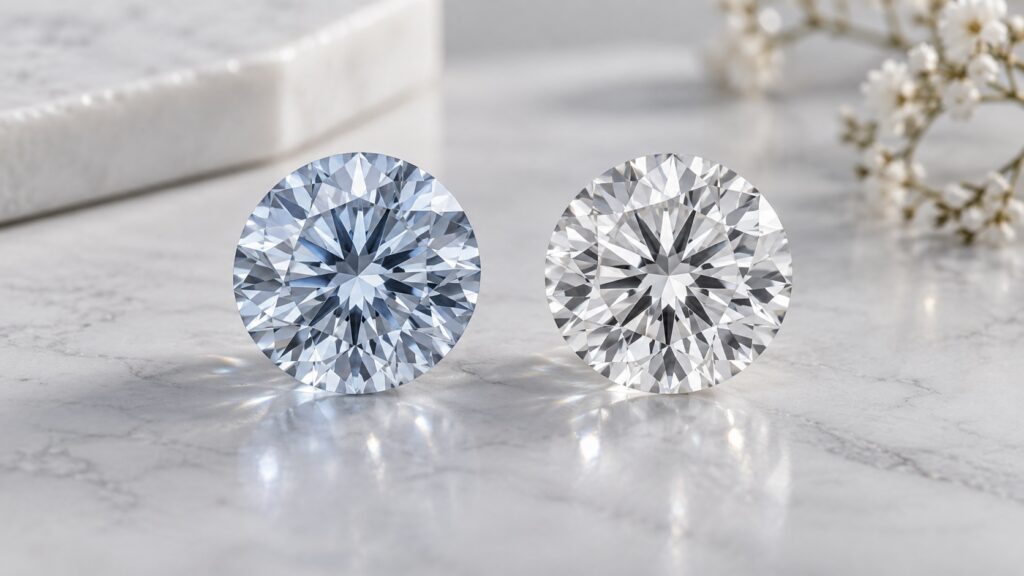
A 2 carat diamond does not look twice as wide as a 1 carat diamond.
Carat measures weight rather than diameter.
A well-proportioned round brilliant might measure approximately:
1 carat: 6.4 to 6.5 mm
2 carats: 8.0 to 8.2 mm
That means the diameter increases by roughly 1.6 mm, or around 25%.
However, diameter alone slightly understates the visual difference because a diamond has two dimensions across its face.
A 2 carat round therefore has substantially more visible surface area than a 1 carat round, even though it does not look literally twice as large.
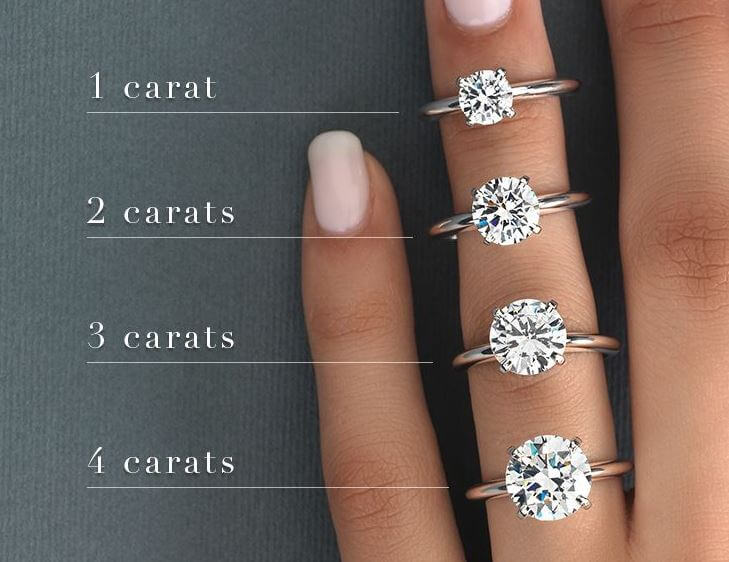
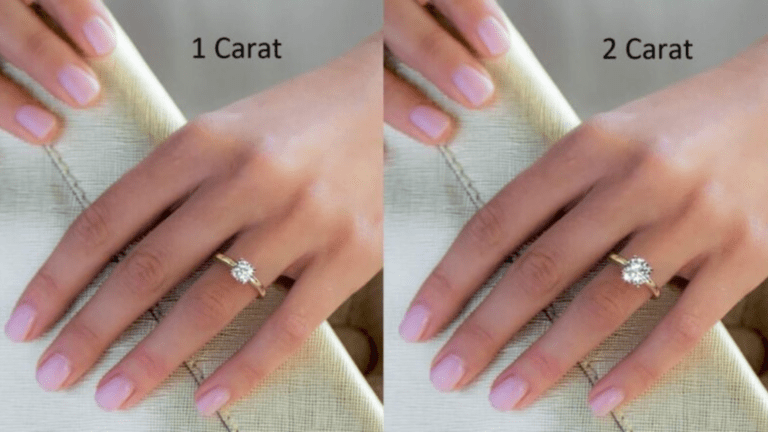
On the finger, the difference is obvious.
A 1 carat diamond tends to look substantial without dominating the hand.
A 2 carat diamond has considerably more presence and can become the defining feature of the ring.
Why Doesn't a 2 Carat Diamond Look Twice as Large?
Because the additional diamond weight is distributed in three dimensions.
Some goes into:
-
Length
-
Width
-
Crown height
-
Pavilion depth
-
Girdle thickness
You are viewing only the top of the diamond when it is worn.
This is also why two diamonds of the same carat weight can have different visible sizes.
A deep 2 carat diamond may hide excessive weight underneath the girdle and face up smaller than expected.
Meanwhile, a well-proportioned 1.90 carat diamond could potentially have very similar visible dimensions.
Always compare millimeter measurements alongside carat weight.
1 Carat vs 2 Carat on the Finger
Finger size and ring design influence how large a diamond appears.
On a smaller finger, a 1 carat stone may already provide substantial coverage.
On a larger finger, 2 carats can look more proportional.
The width of the band matters too.
A thin solitaire band can make the center stone appear larger because there is less surrounding metal competing for attention.
A wide band can make the same diamond seem slightly smaller.
Other designs, including halos and three-stone rings, can create considerably more visual coverage without requiring a 2 carat center stone.
Is a 2 Carat Diamond Twice the Price of 1 Carat?
Usually not.
With natural diamonds, moving from 1 to 2 carats can create a much larger price increase.
There are two main reasons.
First, larger gem-quality natural diamonds are rarer.
Second, diamond pricing is influenced by important carat thresholds, including:
-
1 carat
-
1.5 carats
-
2 carats
-
3 carats
Crossing these milestones can increase the price per carat as well as the total carat weight.
So you are not simply buying twice as much diamond.
You may also be paying a higher price per carat.
This is why the jump from a high-quality 1 carat natural diamond to a comparable 2 carat diamond can be substantial.
Compare Cut Quality Before Carat Weight
If I were choosing between 1 and 2 carat diamonds, I would start with Whiteflash.
Whiteflash is particularly useful for buyers who prioritize cut because its A CUT ABOVE® natural diamonds are selected for extremely precise light performance.
Its Precision Lab collection also makes it possible to compare high-quality lab-grown diamonds if you want 2 carats without paying natural diamond pricing.
Read my Whiteflash review before buying.
Cut Becomes Even More Important at 2 Carats
It is tempting to focus entirely on size when spending more on a 2 carat diamond.
That is a mistake.
A poorly cut 2 carat diamond can:
-
Leak light
-
Appear dark
-
Look smaller than its weight suggests
-
Have weak edge-to-edge brightness
-
Carry unnecessary weight underneath the girdle
A beautifully cut 1.8 or 1.9 carat diamond can sometimes look more impressive than a mediocre 2 carat stone.
I would always choose:
1.80 ct with outstanding light performance
over:
2.00 ct with poor proportions
if the alternative is sacrificing cut purely to reach the milestone.
You can read more about this in my diamond cut guide.
1.8 to 1.99 Carats Can Be a Smart Alternative
If you like the appearance of a 2 carat diamond but do not necessarily care about the number on the grading report, look just below the threshold.
Diamonds around:
1.80 to 1.99 carats
can be particularly interesting.
A well-cut 1.90 carat stone can have dimensions very close to those of some 2 carat diamonds.
That can potentially allow you to avoid part of the premium associated with crossing the full 2 carat milestone.
There is one catch.
High-quality diamonds immediately below important carat thresholds can be harder to find because cutters have a financial incentive to retain enough weight to reach those milestones.
If you find an excellent 1.85 or 1.90 carat stone, do not dismiss it simply because it does not say 2.00 on the certificate.
Does Color Matter More at 2 Carats?
Generally, yes.
As diamonds become larger, subtle body color can become easier to notice.
That does not mean you suddenly need a D-color diamond.
For round brilliants, near-colorless grades such as G and H can still provide an excellent balance between appearance and value.
Depending on the setting and your tolerance for warmth, I would also consider lower grades.
Yellow and rose gold settings can be especially forgiving because the surrounding metal already introduces warmth.
White gold and platinum create a more neutral background, which can make differences in diamond color easier to see.
Read my diamond color guide before paying for unnecessarily high grades.
Does Clarity Matter More?
A larger diamond also gives you a larger window through which inclusions may be visible.
But that does not mean a 2 carat diamond needs VVS clarity.
The goal should still be:
eye-clean clarity.
A carefully selected VS2 can offer excellent value.
Some SI1 diamonds can also be completely eye-clean, although you need to evaluate them individually.
I would not automatically pay for VVS1 or VVS2 just because the diamond is 2 carats.
Once the diamond is genuinely eye-clean, additional clarity exists largely on the grading report rather than in the visible appearance of the ring.
1 vs 2 Carat Oval Diamonds
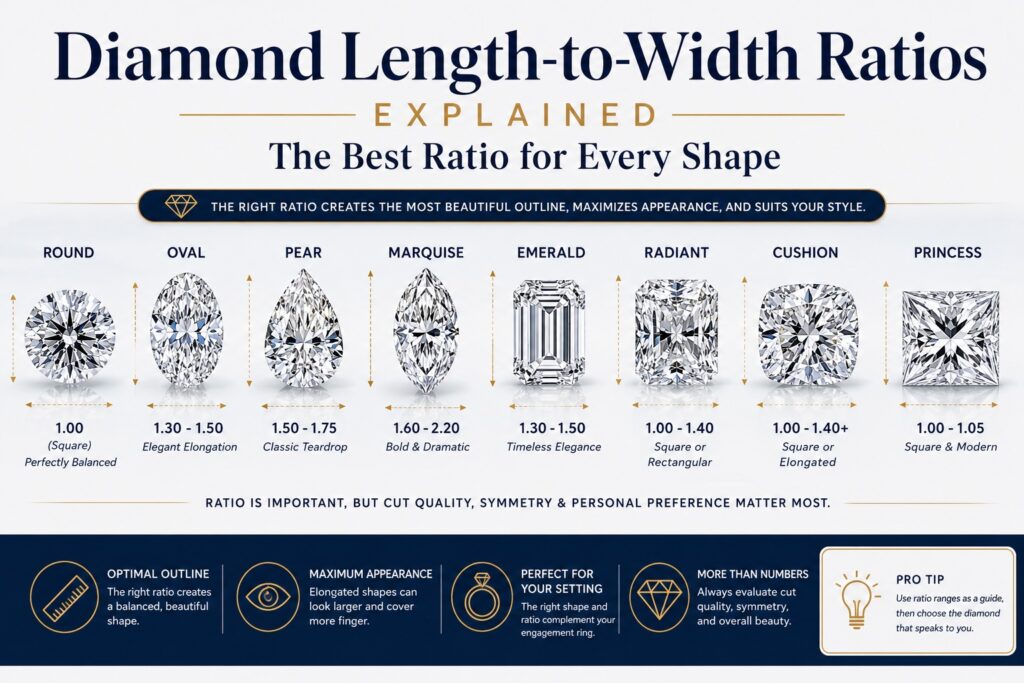
The difference between 1 and 2 carats can feel even more dramatic with elongated shapes.
Oval diamonds spread their weight over a longer outline, giving them excellent finger coverage.
A well-proportioned 1 carat oval can already look relatively large.
At 2 carats, an elongated oval can create substantial visual presence.
However, do not judge an oval by carat weight alone.
Compare:
-
Length
-
Width
-
Length-to-width ratio
-
Depth
-
Bow tie
-
Overall light performance
A poorly proportioned 2 carat oval can carry hidden weight while a lighter stone may spread more attractively across the finger.
What About Radiant and Emerald Cuts?
Radiants and emerald cuts also vary significantly in their face-up dimensions.
An elongated 2 carat radiant can look substantially larger than a compact square radiant of the same weight.
Emerald cuts often carry weight differently because of their step-cut structure.
With either shape, compare the actual length × width measurements rather than relying on carat weight.
1 vs 2 Carat Lab-Grown Diamonds
This is where the comparison changes considerably.
Lab-grown diamonds make 2 carat sizes accessible at a much lower price than equivalent natural diamonds.
As a result, buyers who would previously have chosen around 1 carat may now be comparing:
-
2 carats
-
2.5 carats
-
3 carats
-
Even larger stones
If your priority is visual size rather than rarity, lab-grown diamonds can offer exceptional value.
But the lower price does not mean every 2 carat lab diamond is worth buying.
You still need to evaluate:
-
Cut quality
-
Transparency
-
Color
-
Blue, brown or gray nuance
-
Growth characteristics
-
Certification
-
Actual imagery
My lab-grown diamond guide explains the differences in more detail.
Is 2 Carats Too Big?
For most people, no.
Two carats is large enough to make an obvious statement but remains a very wearable size for an engagement ring.
Whether it feels too large depends on:
-
Finger size
-
Diamond shape
-
Setting
-
Lifestyle
-
Personal taste
A 2 carat round on a small finger can look very substantial.
A 2 carat elongated diamond can cover even more of the finger vertically.
Someone who works extensively with their hands may prefer the lower profile and more understated appearance of a 1 carat stone.
There is no objectively correct size.
Is 1 Carat Still a Good Engagement Ring Size?
Absolutely.
The rise of inexpensive large lab-grown diamonds has distorted perceptions of what constitutes a "large" engagement ring.
A well-cut 1 carat diamond is still a substantial center stone.
It can also allow a natural diamond buyer to focus more of their budget on:
-
Cut
-
Color
-
Clarity
-
Setting quality
rather than spending everything on carat weight.
If your budget is limited, I would rather own a spectacular 1 carat diamond than stretch financially for a compromised 2 carat stone.
Where Else Can You Compare 1 and 2 Carat Diamonds?
Blue Nile is useful if you want a very large searchable inventory and the ability to compare many 1 and 2 carat diamonds across different grades and prices. Read my Blue Nile review.
Brilliant Earth is also worth considering if you want to compare natural and lab-grown diamonds alongside a broad range of engagement ring designs. Read my Brilliant Earth review.
Do not filter only for exactly 1.00 or 2.00 carats. Search slightly above and below each threshold to find the strongest combination of dimensions, cut quality and price.
1 Carat Natural vs 2 Carat Lab-Grown
This has become an increasingly common decision.
Suppose the same overall budget gives you a choice between:
A high-quality 1 carat natural diamond
or:
A high-quality 2 carat lab-grown diamond.
Neither is universally better.
Choose the natural diamond if you place greater importance on:
-
Geological origin
-
Rarity
-
Traditional diamond ownership
-
Natural diamond scarcity
Choose the lab-grown diamond if you prioritize:
-
Visible size
-
Higher carat weight
-
Lower purchase price
-
Getting more diamond for your budget
A lab-grown diamond has essentially the same optical and physical properties as a natural diamond, but its origin and market economics are very different.
Which Offers Better Value?
That depends on what you mean by value.
1 Carat Offers Better Value If:
You want a natural diamond and are trying to balance size with quality.
At 1 carat, you can often allocate more of the budget toward excellent cut and avoid making aggressive compromises elsewhere.
2 Carats Offers Better Value If:
Visible size is a major priority and your budget comfortably supports the larger stone.
This is particularly true with lab-grown diamonds, where moving to 2 carats is much less financially demanding.
Just Under 2 Carats Can Offer the Best Compromise
A high-quality 1.8 to 1.99 carat diamond can deliver much of the visual presence of 2 carats while potentially offering better value.
Do not become obsessed with the exact carat number.
How Much Should You Spend?
There is no correct amount.
Set the total budget first and divide it between:
-
Center diamond
-
Setting
-
Any side stones or pavé
-
Taxes or other costs
Then prioritize the characteristics that actually affect appearance.
My order would generally be:
Cut → Size → Color → Eye-clean clarity
I would not compromise cut simply to reach 2 carats.
Frequently Asked Questions
Is a 2 carat diamond twice as big as a 1 carat?
No.
It weighs twice as much, but it does not have twice the face-up diameter.
A typical 1 carat round measures around 6.4 to 6.5 mm, while a well-proportioned 2 carat round is around 8.0 to 8.2 mm.
Is the difference between 1 and 2 carats noticeable?
Yes.
The visual difference is substantial when similarly proportioned diamonds are viewed side by side.
Why does a 2 carat diamond cost so much more?
Large natural diamonds are rarer, and 2 carats is an important pricing threshold. The price per carat can therefore increase as well as the total diamond weight.
Is a 1.9 carat diamond basically the same size as 2 carats?
It can be extremely close.
Actual dimensions matter more than the 0.10 carat difference.
A well-cut 1.9 carat diamond can potentially have similar face-up measurements to some 2 carat stones.
Is a 2 carat diamond too big for an engagement ring?
For most buyers, no.
Two carats creates substantial presence but remains a practical engagement ring size for many people.
Should I buy a 1 carat natural or 2 carat lab-grown diamond?
Choose natural if rarity and origin matter most. Choose lab-grown if maximizing visible size and value is your priority.
Does a 2 carat diamond need higher clarity?
Not necessarily.
You still only need the diamond to be eye-clean. A carefully selected VS2 or even some SI1 diamonds can offer much better value than unnecessarily high VVS grades.
Does a 2 carat diamond look better?
Not automatically.
A beautifully cut 1 carat diamond can be more impressive than a poorly cut 2 carat stone.
Final Verdict: 1 vs 2 Carat Diamonds
There is a clear visual difference between 1 and 2 carat diamonds.
A 2 carat diamond has substantially more presence on the finger and is a compelling choice if you want a larger center stone.
But it does not look twice as large.
And with natural diamonds, it certainly does not necessarily cost only twice as much.
If you are shopping for a natural diamond and value is important, I would seriously consider:
1.5 to 1.9 carats
rather than automatically stretching to 2.00.
If you specifically want 2 carats, make sure you are not sacrificing cut quality simply to hit the milestone.
For buyers focused on cut, I would start with Whiteflash.
For a much larger inventory to compare across multiple carat weights and budgets, look at Blue Nile.
And if you are considering a 2 carat lab-grown diamond, compare Whiteflash Precision Lab with the natural and lab-grown options available from Brilliant Earth.
Ultimately, I would not choose between 1 and 2 carats based on the certificate alone.
Compare the actual:
-
Dimensions
-
Cut quality
-
Light performance
-
Color
-
Clarity
-
Setting
-
Price
A great 2 carat diamond is undeniably impressive.
But a beautifully cut 1 carat diamond remains far better than a mediocre stone that happens to weigh twice as much.

Jasmine, together with Benjamin (Ben), is the passionate force behind The Diamond Genie. Their journey into the world of diamonds began with their own engagement ring experience, sparking a deep fascination with gemology and the diamond trade. This personal adventure turned into a mission to empower others in their diamond buying decisions. Jasmine’s expertise, honed from extensive study and immersion in the field, drives The Diamond Genie’s commitment to helping customers find the best diamonds for the best value. With a keen eye for quality and value, and a desire to share knowledge with others who might feel overwhelmed by the diamond selection process, Jasmine has made The Diamond Genie a trusted ally for anyone navigating the complexities of diamond purchasing.