Lab-Grown Diamond Color Grades: D vs E vs F Compared
August 13, 2026
What Is Blue Nuance in a Lab-Grown Diamond, and Should You Avoid It?
September 21, 2026Diamond Length-to-Width Ratios Explained: The Best Ratio for Every Shape
Two diamonds can have the same shape, carat weight, color and clarity yet look surprisingly different when placed next to each other.
One of the biggest reasons is their length-to-width ratio.
Length-to-width ratio tells you whether a diamond looks short and broad, perfectly square, classically proportioned or dramatically elongated. It is particularly important when shopping for fancy-shaped diamonds such as ovals, pears, emerald cuts, radiants and marquises.
But there is an important point to understand from the beginning:
There is no single perfect length-to-width ratio for most diamond shapes.
There are ranges that tend to produce attractive, balanced outlines, but personal preference matters enormously. GIA also stresses that a ratio alone cannot communicate the beauty of a fancy-shaped diamond.
This guide explains how diamond length-to-width ratio is calculated, the ranges I recommend for every major diamond shape and what else you should check before purchasing.
Diamond Length-to-Width Ratio: Quick Reference
If you just want the numbers, these are the ranges I would use as a starting point:
| Diamond Shape | Recommended Length-to-Width Ratio | My Preferred Starting Point |
|---|---|---|
| Round | Approximately 1.00 | 1.00 |
| Oval | 1.30-1.50 | 1.40-1.45 |
| Pear | 1.50-1.75 | 1.55-1.65 |
| Marquise | 1.60-2.20 | 1.75-2.00 |
| Emerald | 1.30-1.50 | 1.35-1.45 |
| Radiant, Square | 1.00-1.05 | 1.00-1.05 |
| Radiant, Rectangular | 1.15-1.40 | 1.20-1.35 |
| Cushion, Square | 1.00-1.05 | 1.00-1.05 |
| Cushion, Elongated | 1.10-1.40+ | 1.15-1.30 |
| Princess | 1.00-1.05 | 1.00-1.03 |
| Asscher | 1.00-1.05 | Close to 1.00 |
| Heart | Around 1.00 | 0.95-1.05 |
These are selection ranges rather than grading standards.
An oval at 1.51 can be stunning. A pear at 1.47 may have a beautifully balanced outline. An elongated cushion at 1.35 could be exactly the look you want.
Use the ratio to narrow your search, then judge the actual diamond.
What Is a Diamond Length-to-Width Ratio?
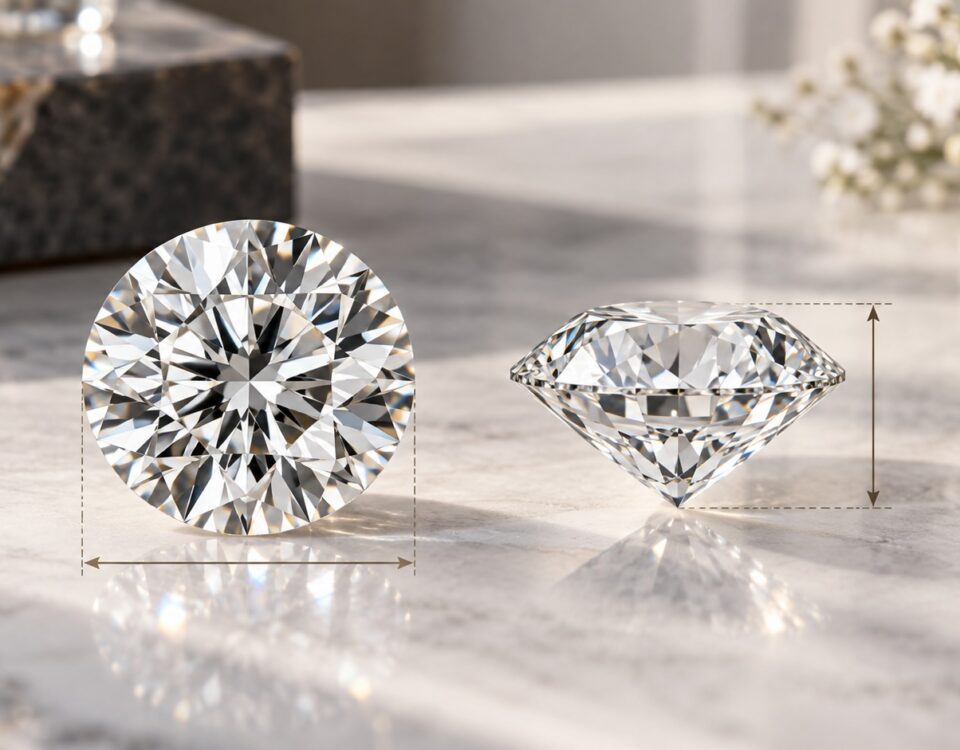
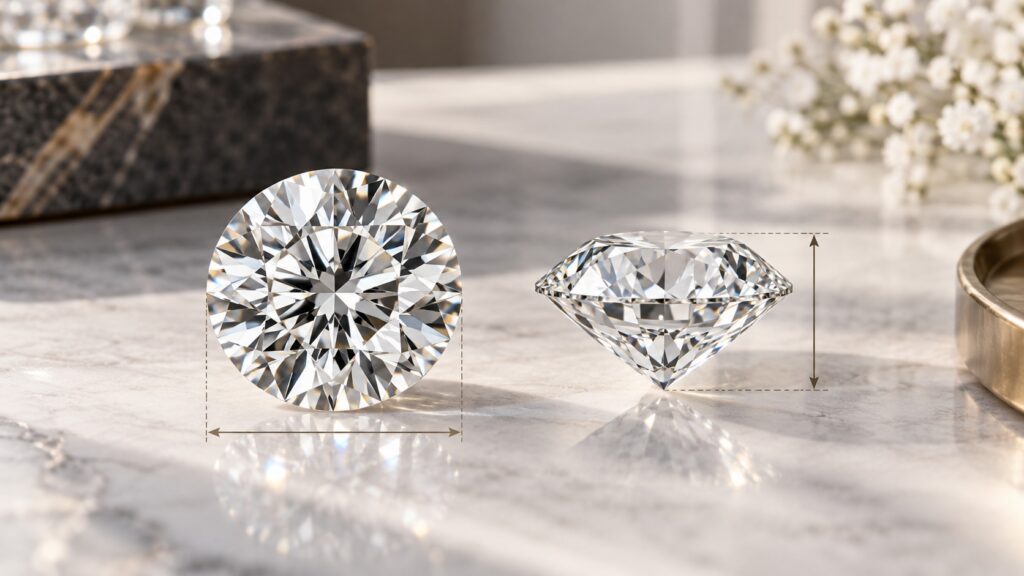
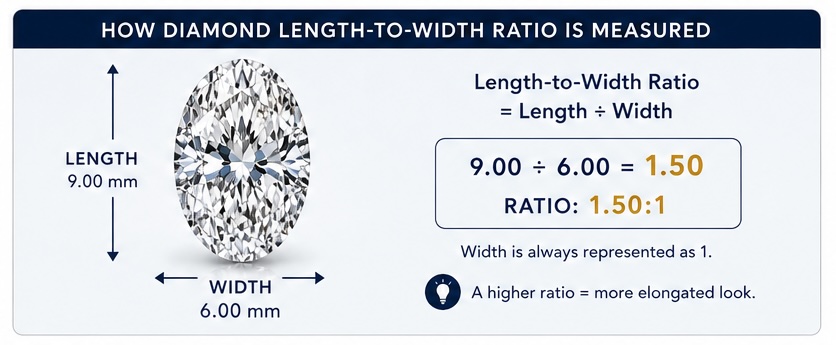
The length-to-width ratio compares a diamond's longest measurement with its width.
It is calculated by dividing:
Length ÷ Width = Length-to-Width Ratio
For example, imagine an oval diamond measures:
9.00 mm long × 6.00 mm wide
9 ÷ 6 = 1.50
Its length-to-width ratio is therefore 1.50:1.
The width is normally expressed as 1, which is why you will see ratios written as 1.40:1, 1.50:1 or 2.00:1.
GIA describes length-to-width ratio as the relationship between the length and width of a fancy-shaped diamond.
Why Does Length-to-Width Ratio Matter?
The ratio has a major effect on a diamond's silhouette.
Take an oval as an example.
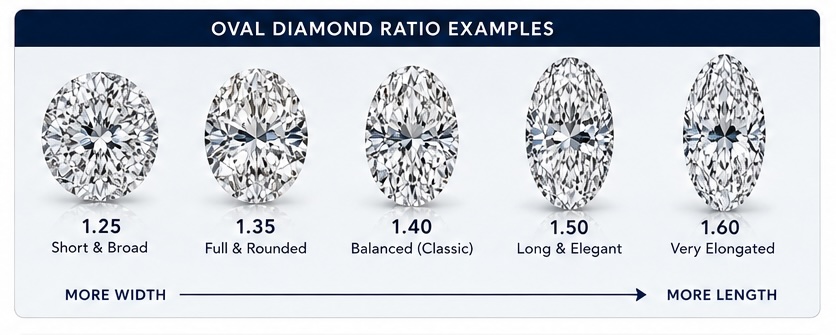
A 1.30 ratio oval will look fairly full and rounded.
A 1.40 oval has a more traditional elongated appearance.
A 1.50 oval looks noticeably longer and slimmer.
None is automatically better.
They simply create different aesthetics.
The same applies to emerald cuts, cushions, radiants, pears and marquise diamonds.
Length-to-width ratio can influence:
-
How elongated the diamond looks
-
How large the diamond appears
-
How much finger coverage it provides
-
Whether the outline looks balanced
-
How the diamond works with a particular setting
-
Whether the shape appears square or rectangular
Elongated shapes such as oval, pear and marquise diamonds can also appear larger for their carat weight than more compact shapes. GIA notes that the outline of elongated diamonds can increase perceived face-up size, although carat weight and shape alone do not guarantee that one diamond will look larger than another.
For more on this distinction, read my diamond carat guide.
Length-to-Width Ratio Is Not the Same as Cut Quality
This distinction is extremely important.
A diamond having the "right" ratio does not mean it is well cut.
Length-to-width ratio describes the outline.
Diamond cut quality considers far more, including how proportions, facet arrangement, symmetry and finish influence the way a diamond handles light.
For a round brilliant, GIA provides an overall cut grade.
For fancy shapes such as ovals, pears, cushions, marquises, emerald cuts and princess cuts, GIA does not currently provide the same overall cut grade because their facet structures and appearances vary too widely.
That makes visual assessment particularly important when buying fancy-shaped diamonds.
A 1.42 oval is not necessarily better than a 1.48 oval.
A 1.40 emerald is not automatically better than a 1.32 emerald.
You still need to evaluate the actual stone.
Read my guide to diamond light-performance imaging to understand some of the tools that can help assess diamond performance beyond the grading report.
Best Length-to-Width Ratio for Every Diamond Shape
Let's look at each shape individually.
Round Diamond Length-to-Width Ratio
Best ratio: approximately 1.00:1
A properly shaped round brilliant should be essentially circular.
That means its length and width should be extremely close to identical.
For example:
6.50 × 6.47 mm
produces a ratio extremely close to 1.00.
Unlike elongated fancy shapes, you should not be choosing between a "short" and "long" round diamond.
If a supposed round diamond shows a noticeably uneven outline, I would investigate its symmetry and measurements carefully.
With round diamonds, however, length-to-width ratio is nowhere near as useful as the proportions controlling actual light performance.
Pay far more attention to:
-
Cut quality
-
Crown angle
-
Pavilion angle
-
Table percentage
-
Depth percentage
-
Symmetry
-
Light-performance imagery
GIA's formal cut-grading system is specifically designed around the standard round brilliant and evaluates brightness, fire, scintillation, weight ratio, durability, polish and symmetry.
For more information, read my diamond cut guide and guide to the 4Cs of diamond quality.
Oval Diamond Length-to-Width Ratio
Recommended: 1.30-1.50
My sweet spot: 1.40-1.45
Oval diamonds are one of the shapes where length-to-width ratio makes the biggest visual difference.
GIA suggests:
-
1.30-1.40: A fuller, more rounded oval
-
1.40-1.50: A more traditional elongated oval
GIA describes 1.40-1.50 as the most popular traditional range.
My preference is generally around 1.40-1.45.
That provides enough elongation to clearly distinguish the diamond from a round while avoiding an overly narrow appearance.
What Different Oval Ratios Look Like
| Oval Ratio | Appearance |
|---|---|
| 1.25-1.30 | Short, broad and rounded |
| 1.30-1.39 | Soft, full oval |
| 1.40-1.45 | Classic balanced oval |
| 1.46-1.50 | Long and elegant |
| 1.50+ | Very elongated and dramatic |
There is no problem with going beyond 1.50 if you genuinely prefer a long oval.
The bigger issue is light performance.
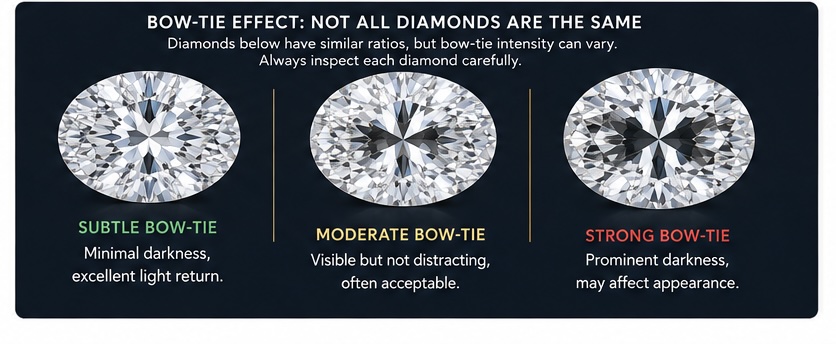
Ovals can exhibit a dark bow-tie across their center, and the ratio cannot tell you whether that bow tie will be attractive, subtle or distracting. GIA specifically recommends inspecting ovals visually because bow-tie visibility varies between individual stones even within the same ratio range.
So do not buy an oval from measurements alone.
Pear Diamond Length-to-Width Ratio
Recommended: 1.50-1.75
My sweet spot: 1.55-1.65
The pear is another shape where outline is incredibly important.
GIA notes that many experts favor pears with a length-to-width ratio of approximately 1.50-1.75, while also emphasizing that personal preference should ultimately guide the decision.
I normally prefer the slightly tighter 1.55-1.65 range.
It creates a recognizable teardrop without making the stone look excessively long or narrow.
Pear Ratio Guide
| Pear Ratio | Appearance |
|---|---|
| Below 1.50 | Shorter, fuller pear |
| 1.50-1.55 | Full traditional shape |
| 1.55-1.65 | Balanced and elegant |
| 1.65-1.75 | Slim and elongated |
| Above 1.75 | Very long, dramatic pear |
Do not judge a pear by ratio alone.
The shoulders and wings need to work together.
GIA recommends looking for gently rounded shoulders and attractive wings. Wings that are too flat can make the diamond appear narrow, while overly rounded wings can create a short, stubby outline.
Symmetry is especially important.
Imagine drawing a line from the point through the center of the diamond. The left and right sides should mirror each other closely.
A 1.60 pear with poor shoulders is not preferable to a beautiful 1.52 pear simply because the ratio sits closer to someone's idea of "ideal."
Marquise Diamond Length-to-Width Ratio
Recommended: approximately 1.60-2.20
My preferred range: 1.75-2.00
Marquise diamonds naturally have one of the highest length-to-width ratios.
GIA reports that marquise diamonds submitted to its laboratories commonly fall between approximately 1.60:1 and 2.20:1.
At the lower end, the diamond looks fuller.
At the upper end, it becomes noticeably longer and thinner.
Marquise Ratio Guide
| Marquise Ratio | Appearance |
|---|---|
| 1.60-1.74 | Shorter and fuller |
| 1.75-1.90 | Balanced |
| 1.90-2.00 | Elegant and elongated |
| 2.00-2.20 | Long and dramatic |
| Above 2.20 | Extremely slender |
For most engagement rings, I would initially search around 1.75-2.00.
Marquise diamonds can provide excellent finger coverage and often look particularly large relative to their carat weight.
However, more elongation is not automatically better.
GIA notes that very long marquise stones can become more challenging to facet while maintaining attractive brightness and pattern, while extremely short versions can appear stubby.
As with ovals and pears, inspect for bow-tie effects.
Emerald Cut Diamond Length-to-Width Ratio
Recommended: approximately 1.30-1.50
My sweet spot: 1.35-1.45
Emerald-cut diamonds vary considerably in shape.
You can find:
-
Almost-square emeralds
-
Broad rectangular stones
-
Classic rectangular emeralds
-
Long, elegant emerald cuts
For the traditional look, I generally prefer 1.35-1.45.
A ratio nearer 1.30 produces a broader diamond.
Moving toward 1.50 creates a longer, slimmer profile.
Emerald Ratio Guide
| Emerald Ratio | Appearance |
|---|---|
| 1.20-1.29 | Very broad |
| 1.30-1.34 | Short rectangle |
| 1.35-1.45 | Classic emerald |
| 1.46-1.55 | Elongated |
| 1.55+ | Very long and slender |
GIA notes more broadly that length-to-width ratios are an important consideration in fancy shapes and that rectangular emerald cuts can be found across elongated proportions.
With an emerald cut, however, ratio is only part of the story.
Emeralds use a step-cut faceting style, producing the famous hall-of-mirrors appearance rather than the intense splintery sparkle associated with brilliant cuts. GIA distinguishes emerald step cuts from brilliant-style shapes such as radiant diamonds.
That means you should closely inspect:
-
Facet pattern
-
Contrast
-
Symmetry
-
Transparency
-
Windowing
-
Clarity
-
Face-up dimensions
Because the large facets are revealing, also read my diamond clarity guide before choosing an emerald.
Radiant Diamond Length-to-Width Ratio
Radiants are particularly flexible because they work beautifully as either square or rectangular diamonds.
Square radiant: 1.00-1.05
Elongated radiant: 1.15-1.40
My elongated sweet spot: 1.20-1.35
If you want a square radiant, stay close to 1.00.
If you want an elongated radiant, I would begin around 1.20-1.35 and adjust according to personal taste.
Radiant Ratio Guide
| Radiant Ratio | Appearance |
|---|---|
| 1.00-1.05 | Square |
| 1.06-1.14 | Slightly rectangular |
| 1.15-1.25 | Moderately elongated |
| 1.26-1.35 | Clearly elongated |
| 1.35+ | Long radiant |
GIA makes an important point about radiants: their proportions can vary considerably, so the best option should be judged visually rather than by a single numerical formula.
GIA specifically recommends looking for a centered culet, parallel sides and even corners.
I agree.
Two radiants with exactly the same 1.30 ratio can still have very different outlines and very different light performance.
Cushion Diamond Length-to-Width Ratio
Cushions have become especially interesting because both square and elongated cushion diamonds are popular.
Square cushion: 1.00-1.05
Slightly elongated: 1.06-1.15
Elongated cushion: 1.15-1.30
Very elongated cushion: 1.30+
There is no single "best" cushion ratio because the desired silhouette is part of what defines the style.
GIA notes that cushion cuts naturally come in considerable variety, ranging from rounded-square forms to noticeably elongated rectangular versions.
Cushion Ratio Guide
| Cushion Ratio | Appearance |
|---|---|
| 1.00-1.05 | Traditional square cushion |
| 1.06-1.14 | Slight elongation |
| 1.15-1.25 | Elongated cushion |
| 1.26-1.35 | Strongly elongated |
| 1.35+ | Very elongated modern look |
For a traditional cushion, I prefer 1.00-1.05.
For an elongated cushion, I would initially search around 1.15-1.30.
But cushions vary enormously in more than their outline.
GIA notes that modern cushion diamonds can have different facet arrangements as well as different proportions.
That means two cushions with an identical 1.20 ratio can look completely different.
Always inspect the actual facet pattern.
Princess Diamond Length-to-Width Ratio
Best ratio for a square princess: 1.00-1.05
My preference: 1.00-1.03
Most people purchasing a princess-cut diamond want it to look square.
GIA states that a square princess cut should have a length-to-width ratio of no more than approximately 1.05:1.
That makes this one of the simpler shapes to shop by ratio.
Princess Ratio Guide
| Princess Ratio | Appearance |
|---|---|
| 1.00 | Perfectly square |
| 1.01-1.03 | Visually square |
| 1.04-1.05 | Slight deviation, usually still square-looking |
| 1.06+ | Increasingly rectangular |
I would normally target 1.00-1.03.
Once the ratio starts moving noticeably beyond 1.05, ask yourself whether you actually want a rectangular princess.
GIA notes that rectangular princess cuts exist and can extend farther, but the classic princess aesthetic is square.
Also pay careful attention to the corners.
Princess diamonds have sharp points, so the engagement-ring setting needs to protect them appropriately. Read my guide to choosing a ring setting for more on matching diamond shape with setting style.
Asscher Diamond Length-to-Width Ratio
Best ratio: close to 1.00
Recommended: approximately 1.00-1.05
Asscher diamonds are meant to have a square, highly symmetrical appearance.
For that reason, I would search as close to 1.00 as reasonably possible.
Ratios up to around 1.05 can still appear square to the eye, but I see little reason to intentionally choose a noticeably rectangular Asscher unless the unusual outline specifically appeals to you.
Asschers are step cuts, so their beauty comes from geometric facet patterns, contrast and the hall-of-mirrors effect rather than simply maximizing brilliance.
That makes symmetry particularly important.
As with emerald cuts, clarity can also be more visible through the broad open facets. Read my diamond clarity guide when comparing Asschers.
Heart Diamond Length-to-Width Ratio
Best ratio: approximately 1.00
Recommended: around 0.95-1.05
The heart is one of the shapes where symmetry and outline matter enormously.
GIA suggests that an attractive heart-shaped diamond has a length-to-width ratio of approximately 1.00:1.
That makes sense because a classic heart should look balanced rather than stretched vertically or compressed horizontally.
But the ratio alone is not enough.
Look for:
-
Two matching lobes
-
A clear cleft
-
Balanced wings
-
An attractive point
-
Strong left-to-right symmetry
GIA specifically emphasizes that the two halves should be identical or closely matched and that the cleft and lobes should be well defined.
With hearts, I would choose the better outline over the mathematically more perfect ratio every time.
Does a Higher Length-to-Width Ratio Make a Diamond Look Bigger?
Often, but not automatically.
Increasing the ratio of an oval, pear, marquise, radiant or emerald cut generally makes the stone more elongated.
That can increase the apparent finger coverage.
This is one reason elongated shapes can look larger than round or square diamonds at similar carat weights. GIA recognizes that elongated outlines can contribute to the perception of greater size.
But there is a trap.
Do not chase spread at the expense of everything else.
A diamond can look large because it is shallow, poorly proportioned or stretched into an unattractive outline.
Carat weight is also a measurement of weight, not diameter or surface area.
The Diamond Genie's carat guide explains why two diamonds with identical carat weights can have different face-up dimensions.
Length-to-Width Ratio vs Carat Weight
Consider two hypothetical 2 carat oval diamonds:
Diamond A: 10.2 × 7.3 mm
Ratio: approximately 1.40
Diamond B: 11.0 × 6.9 mm
Ratio: approximately 1.59
Both weigh 2 carats.
Diamond B is much longer and narrower.
That does not automatically make it better.
Some buyers will prefer its dramatic appearance. Others will think Diamond A looks more balanced.
The ratio tells you shape, not beauty.
This is a crucial distinction.
Can Length-to-Width Ratio Tell You if a Diamond Is Well Cut?
No.
This is probably the biggest mistake shoppers make with fancy-shaped diamonds.
Imagine you have two ovals:
-
Oval A: 1.42 ratio
-
Oval B: 1.42 ratio
They could still differ dramatically in:
-
Bow-tie visibility
-
Brightness
-
Symmetry
-
Facet pattern
-
Depth
-
Spread
-
Transparency
-
Overall attractiveness
Length-to-width ratio uses only two measurements.
A diamond is a complex three-dimensional optical object.
For rounds, GIA can apply an overall cut grade using a standardized system. Fancy shapes do not currently receive the same GIA overall cut grade.
That makes high-resolution imagery especially valuable.
Watch Out for the Bow-Tie Effect
Oval, pear and marquise diamonds can display an area of darkness running across their center known as a bow tie.
Heart shapes can show one too.
The presence and severity cannot be predicted reliably from length-to-width ratio alone.
GIA's recent research into oval, pear and marquise diamonds also demonstrates how much outline characteristics can vary independently of the basic ratio. Stones with similar ratios can have different shoulders, wings and point geometry.
This is exactly why I dislike rigid online rules such as:
"Only buy an oval between 1.40 and 1.45."
That range can be a useful search filter.
It cannot select the diamond for you.
Symmetry Matters as Much as Ratio
Fancy-shaped diamonds often depend heavily on symmetry for their visual appeal.
This is particularly important for:
-
Oval
-
Pear
-
Marquise
-
Heart
-
Princess
-
Asscher
An ideal numerical ratio cannot rescue a visibly asymmetric outline.
When shopping online, look straight down at the diamond.
For symmetrical shapes, imagine a line running vertically through its center.
Ask:
-
Do both halves match?
-
Are the shoulders balanced?
-
Are the points centered?
-
Is one side fuller?
-
Are the corners consistent?
-
Does the diamond appear tilted even when it is not?
These visual checks often reveal more than the ratio itself.
How to Find the Length-to-Width Ratio on a Diamond Certificate
Diamond grading reports provide the physical measurements of the stone.
If the ratio is not stated explicitly, you can calculate it yourself:
Length ÷ Width
For example:
10.50 × 7.50 × 4.60 mm
10.50 ÷ 7.50 = 1.40
The diamond therefore has a 1.40 length-to-width ratio.
When buying a natural diamond, I generally prefer an independent grading report from a respected laboratory such as GIA.
Read my GIA diamond certification guide and broader diamond certification guide before purchasing.
What Length-to-Width Ratio Looks Biggest?
If visual size is your priority, elongated shapes are worth considering.
In general:
Marquise provides exceptional length for its carat weight.
Oval provides excellent finger coverage while retaining a softer outline.
Pear gives a similarly elongated look with a distinctive point.
Elongated radiant and cushion cuts combine greater length with broad rectangular shapes.
Emerald cuts can create substantial visual presence because of their long rectangular outline.
However, do not simply choose the highest available ratio.
There is a point where elegant becomes excessively narrow.
The goal should be a diamond that combines visual size with a pleasing outline and good light performance.
Does Finger Shape Affect the Best Ratio?
Potentially.
This is an aesthetic decision rather than a gemological rule, but elongated diamonds can visually lengthen the finger.
If you want this effect, consider:
-
Oval
-
Marquise
-
Pear
-
Elongated emerald
-
Elongated radiant
-
Elongated cushion
A higher ratio within the normal range increases this effect.
If you prefer a softer or more substantial-looking center stone, move toward the lower end of the ratio range.
For example:
Oval: 1.35 rather than 1.50
Pear: 1.50 rather than 1.70
Emerald: 1.30 rather than 1.50
The setting also matters enormously. My engagement ring setting guide covers the major options.
Should You Buy Outside the Recommended Ratio?
Absolutely, if you prefer the diamond.
The idea of an "ideal" fancy-shape ratio is frequently overstated online.
Consider a pear.
GIA notes that many experts like 1.50-1.75, but explicitly says the ideal ratio can come down to what appeals to your own eye.
The same principle applies across most fancy shapes.
A gorgeous 1.48 pear with an exceptional outline is a better purchase than an awkward 1.60 pear simply because 1.60 falls within somebody's spreadsheet.
Use ratios as filters.
Do not use them as pass/fail grades.
Looking for a Precision-Cut Diamond?
For buyers who want exceptional cut quality and detailed diamond imaging, I recommend starting with Whiteflash. Its inventory is particularly strong for buyers who want to go beyond basic certificate specifications and examine actual light performance. Read my full Whiteflash review before shopping.
How I Would Search for Each Shape
If I were setting initial filters today, I would use:
Round
1.00, then concentrate on actual cut quality.
Oval
1.35-1.50, with 1.40-1.45 as my first search.
Pear
1.50-1.70, beginning around 1.55-1.65.
Marquise
1.70-2.10, with 1.75-2.00 as the balanced zone.
Emerald
1.30-1.50, starting around 1.35-1.45.
Radiant
1.00-1.05 for square or 1.15-1.40 for elongated.
Cushion
1.00-1.05 for square or 1.10-1.35 for elongated.
Princess
1.00-1.05, preferably very close to 1.00.
Asscher
1.00-1.05, again preferably near 1.00.
Heart
Approximately 1.00, then judge symmetry and outline carefully.
Once those filters produced a manageable shortlist, I would stop worrying about the exact ratio and start looking at the diamonds themselves.
That second stage is where the best stone is usually found.
Compare a Wider Selection
If you want to compare a large number of fancy-shaped diamonds across different ratios, Blue Nile is useful because of the breadth of its inventory. You can also read my full Blue Nile review.
Buyers particularly interested in combining unusual diamond shapes with a broad range of contemporary settings can also explore Brilliant Earth and my Brilliant Earth review.
Frequently Asked Questions
What Is the Best Length-to-Width Ratio for an Oval Diamond?
For most buyers, 1.30-1.50 is a strong range.
GIA describes 1.30-1.40 as fuller and more rounded, while 1.40-1.50 creates the traditional elongated oval appearance.
My personal starting point is around 1.40-1.45.
What Is the Best Length-to-Width Ratio for a Pear Diamond?
Approximately 1.50-1.75 is widely favored, with GIA noting this as a range preferred by many experts.
I generally prefer around 1.55-1.65 for a balanced pear.
What Is the Best Length-to-Width Ratio for an Emerald Cut?
I recommend beginning around 1.30-1.50, with 1.35-1.45 producing the classic rectangular appearance I tend to favor.
Longer ratios create a slimmer and more dramatic emerald.
What Is the Best Length-to-Width Ratio for a Marquise?
GIA reports that marquise diamonds commonly fall between 1.60 and 2.20.
I would generally begin between 1.75 and 2.00.
What Is the Best Length-to-Width Ratio for a Cushion?
For a square cushion, stay around 1.00-1.05.
For an elongated cushion, begin around 1.10-1.30, although longer cushions can also be attractive.
GIA specifically notes that cushions are available in both squarish and elongated forms.
What Is the Best Length-to-Width Ratio for a Radiant?
For a square radiant, aim close to 1.00-1.05.
For an elongated radiant, I recommend initially looking between 1.15 and 1.40, with approximately 1.20-1.35 providing a versatile rectangular appearance.
Is a 1.5 Ratio Good for an Oval Diamond?
Yes.
A 1.50 oval sits at the elongated end of the range GIA identifies as popular and will provide a noticeably long, elegant appearance.
If you prefer a fuller oval, move toward 1.35-1.40.
Does Length-to-Width Ratio Affect Diamond Price?
Not in isolation in the way carat, color and clarity do.
However, certain silhouettes may be more fashionable or desirable, and the cutter's decisions regarding shape and weight retention affect the final diamond.
You should therefore compare actual stones rather than assuming that one ratio will automatically cost more.
Read my diamond carat guide for more on how diamond weight and visible size relate.
Final Verdict: What Is the Best Diamond Length-to-Width Ratio?
The best length-to-width ratio is ultimately the one that gives you the outline you find most attractive.
If you want simple starting points, I would use:
| Shape | My Starting Range |
|---|---|
| Round | 1.00 |
| Oval | 1.40-1.45 |
| Pear | 1.55-1.65 |
| Marquise | 1.75-2.00 |
| Emerald | 1.35-1.45 |
| Rectangular Radiant | 1.20-1.35 |
| Square Radiant | 1.00-1.05 |
| Elongated Cushion | 1.15-1.30 |
| Square Cushion | 1.00-1.05 |
| Princess | 1.00-1.03 |
| Asscher | Around 1.00 |
| Heart | Around 1.00 |
But I would never purchase a fancy-shaped diamond based solely on that table.
A length-to-width ratio can tell you whether a diamond is broad, square or elongated.
It cannot tell you whether the stone has an attractive facet pattern, severe bow tie, poor transparency, uneven outline or disappointing light performance.
Start with the ratio.
Then inspect:
-
Overall outline
-
Symmetry
-
Face-up dimensions
-
Light performance
-
Bow-tie visibility where relevant
-
Depth and weight distribution
-
Color and clarity
-
Certification
-
How the diamond actually looks
That final point matters most.
The numbers should help you find a beautiful diamond, not convince you to buy one that your eyes are telling you is wrong.

Jasmine, together with Benjamin (Ben), is the passionate force behind The Diamond Genie. Their journey into the world of diamonds began with their own engagement ring experience, sparking a deep fascination with gemology and the diamond trade. This personal adventure turned into a mission to empower others in their diamond buying decisions. Jasmine’s expertise, honed from extensive study and immersion in the field, drives The Diamond Genie’s commitment to helping customers find the best diamonds for the best value. With a keen eye for quality and value, and a desire to share knowledge with others who might feel overwhelmed by the diamond selection process, Jasmine has made The Diamond Genie a trusted ally for anyone navigating the complexities of diamond purchasing.