Diamond Length-to-Width Ratios Explained: The Best Ratio for Every Shape
August 14, 2026
Can a Diamond Be Too Deep? Depth Percentage and Face-Up Size Explained
September 21, 2026Lab-grown diamonds can look every bit as bright, white, and beautiful as natural diamonds, but there are some growth-related characteristics that shoppers need to understand before buying.
One of them is blue nuance.
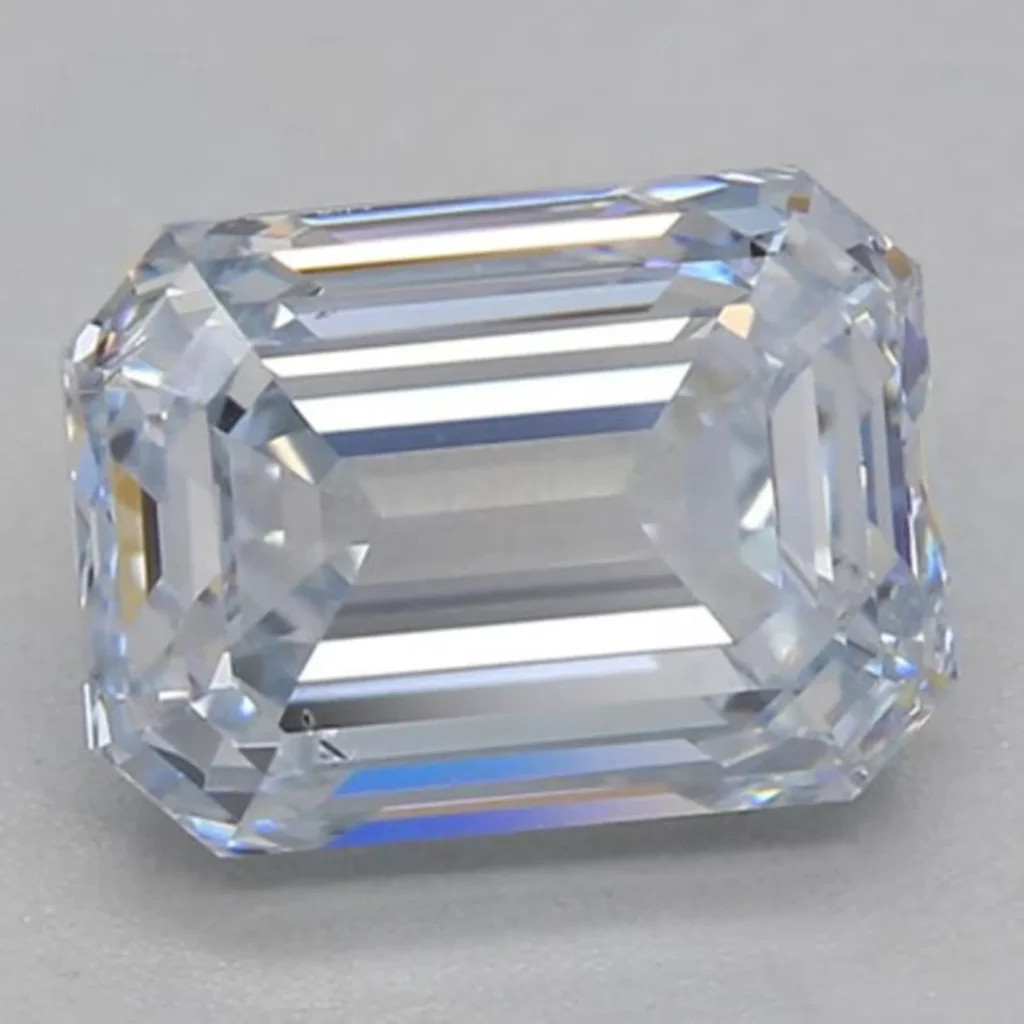
Blue nuance is a subtle blue, gray-blue, or sometimes slightly greenish-blue body color that can appear in certain lab-grown diamonds. It is most strongly associated with diamonds grown using the HPHT, or High Pressure High Temperature, process, where trace amounts of boron can become incorporated into the diamond crystal.

In very small amounts, boron may have no visible effect at all. At higher concentrations, it can produce a noticeable cool blue appearance.
That leads to an important distinction:
A lab-grown diamond can contain boron without looking blue.
The question is not simply whether the diamond is HPHT-grown or whether boron is present. The important question is whether you can actually see an unwanted blue tint in normal viewing conditions.
My general recommendation is straightforward:
I would avoid a lab-grown diamond with an obvious blue nuance unless you specifically like the appearance and the price reflects it.
A very subtle cool appearance that cannot be detected face-up under normal lighting is much less concerning.
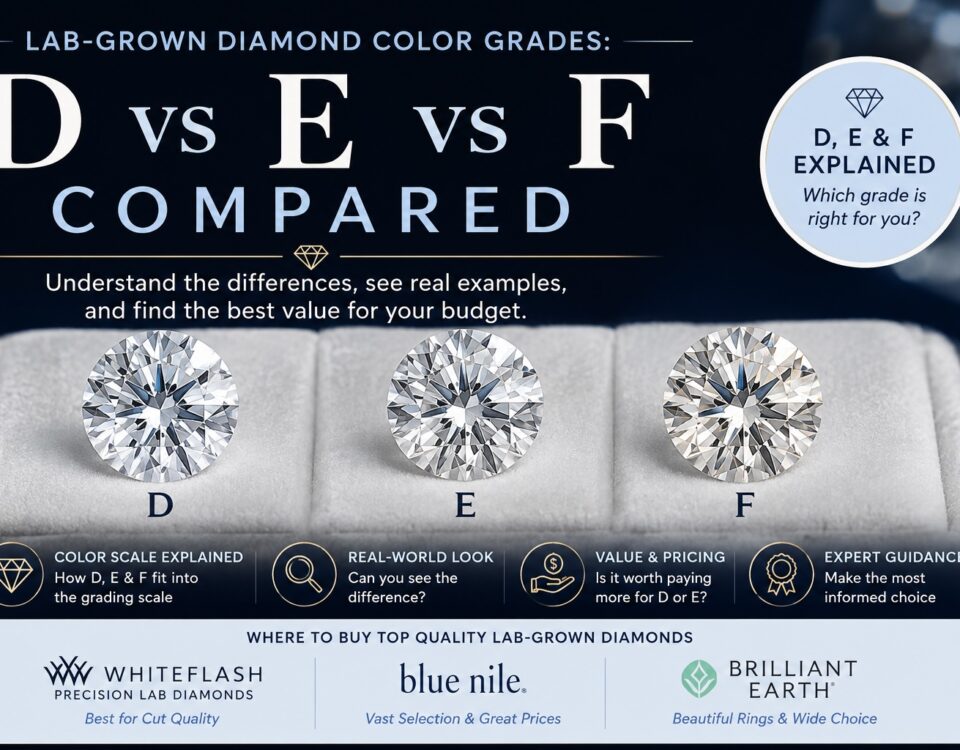
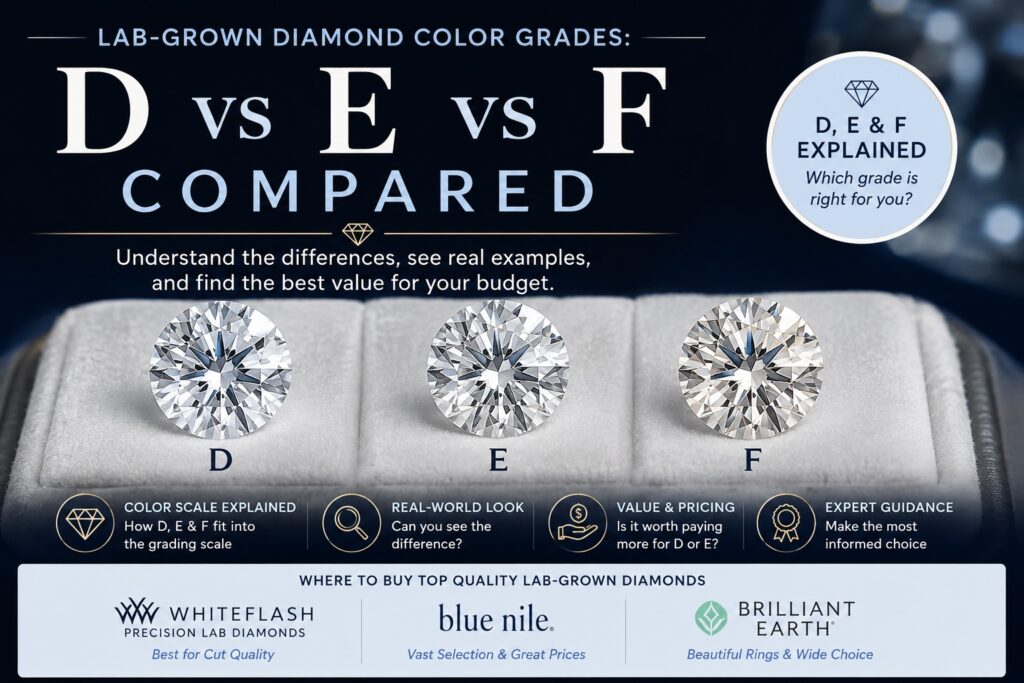
If you are new to lab-created diamonds, start with my complete guide to lab-grown diamonds and my comparison of D vs. E vs. F lab-grown diamond color grades.
Blue Nuance in Lab-Grown Diamonds at a Glance
| Characteristic | What It Means |
|---|---|
| Blue nuance | A subtle blue or blue-gray body tint |
| Most associated with | HPHT-grown diamonds |
| Typical cause | Trace boron incorporated during growth |
| Does every HPHT diamond have it? | No |
| Does every boron-containing diamond look blue? | No |
| Same as fluorescence? | No |
| Same as phosphorescence? | No |
| Same as a Fancy Blue diamond? | No |
| Does it affect durability? | Generally no |
| Can it affect appearance? | Yes |
| Should you avoid it? | Usually if clearly visible and unwanted |
| Can reports always tell you? | Do not rely on the report alone |
Blue nuance is therefore primarily an appearance and quality-selection issue, rather than a durability problem.
A lab-grown diamond with blue nuance is still a diamond.
The concern is whether you want a nominally colorless diamond to have a noticeable secondary blue appearance.
What Causes Blue Nuance in Lab-Grown Diamonds?
Lab-grown diamonds are principally produced using two methods:
- HPHT: High Pressure High Temperature
- CVD: Chemical Vapor Deposition
You can read more about both processes in my lab-grown diamond guide.
Blue nuance is most commonly associated with HPHT-grown diamonds.
During HPHT growth, trace elements can become incorporated into the developing diamond crystal. One of the most important is boron.
When sufficient uncompensated boron is present, it can absorb portions of visible light in a way that produces a blue appearance.
This is not unique to lab-grown diamonds. Boron is also responsible for the blue color found in rare natural Type IIb diamonds.
The major difference is rarity and context.
A naturally blue diamond can be extraordinarily rare and valuable.
A blue nuance in a nominally colorless lab-grown diamond is generally considered a growth-related appearance characteristic, rather than a desirable fancy-color feature.
Importantly, very small amounts of boron do not necessarily create visible color.
That is why shoppers should avoid simplistic rules such as:
"HPHT diamonds are blue."
They are not.
Modern HPHT production can produce extremely colorless diamonds.
The individual stone needs to be assessed.
What Does Blue Nuance Actually Look Like?
The appearance can range from almost imperceptible to immediately obvious.
A very mild example might simply look:
- Slightly cool
- Icy
- Steely
- Blue-white
A stronger blue nuance may appear:
- Clearly pale blue
- Blue-gray
- Greenish-blue
- Unnaturally cool beside a neutral diamond
The difficulty is that diamond photography can make these distinctions harder to judge.
A cool studio lighting environment may make a neutral diamond appear blue.
Likewise, reflections from:
- Cameras
- Clothing
- Computer screens
- Blue backgrounds
- White balance
can create blue reflections that have nothing to do with the diamond's actual body color.
That is why I would never reject a diamond because of a single blue-looking frame in a rotating video.
Instead, look at the diamond throughout the complete rotation and ask whether the blue appearance is persistent throughout the body of the stone.
Blue Nuance Is Not the Same as Diamond Color Grade
This is one of the most important points to understand.
Traditional diamond color grading on the D-to-Z scale primarily assesses the degree of colorlessness relative to the laboratory's grading standards.
You may therefore encounter lab-grown diamonds with impressive specifications such as:
D color, VVS2 clarity
yet find that one has a slightly cooler or bluer appearance than another diamond with the same grade.
This is why I argued in my guide to D vs. E vs. F lab-grown diamonds that shoppers should not assume two diamonds with the same color grade will necessarily look identical.
Lab-grown diamond quality needs to be evaluated beyond the basic certificate.
I would consider:
- Body color
- Blue, gray, or brown nuance
- Transparency
- Cut quality
- Growth-related graining
- Strain
- Actual video
- Light performance
A report is essential, but it is not a substitute for examining the diamond.
Is Blue Nuance the Same as Fluorescence?
No.
Blue nuance and blue fluorescence are completely different phenomena.
Blue nuance describes the body color of the diamond under ordinary viewing conditions.
Fluorescence describes how a diamond reacts when exposed to ultraviolet light.
A diamond with blue fluorescence may look completely neutral under ordinary daylight or indoor lighting.
Under ultraviolet radiation, however, it may emit visible blue light.
Blue nuance is different because the cool coloration can be present during normal viewing.
A diamond could theoretically have:
- Blue nuance but no meaningful fluorescence
- Fluorescence but no blue nuance
- Both characteristics
- Neither characteristic
Do not assume that a blue-looking HPHT diamond is simply fluorescing.
Blue Nuance Is Also Different From Phosphorescence
Phosphorescence is another characteristic sometimes associated with lab-grown diamonds, particularly certain HPHT material.
Fluorescence occurs while the ultraviolet source is present.
Phosphorescence can continue after the UV source has been switched off.
This can produce an afterglow for a period of time.
Again, that is different from blue nuance.
A diamond can contain trace boron that contributes to phosphorescence without necessarily displaying an obvious blue body color during everyday wear.
From a normal jewelry-buying perspective, I care much more about:
What does the diamond look like when you are actually wearing it?
An unattractive blue-gray body color affects your experience every time you look at the stone.
A laboratory characteristic that can only be identified under specialized conditions may have little practical visual importance.
Is Blue Nuance the Same as a Fancy Blue Lab-Grown Diamond?
No.
A Fancy Blue lab-grown diamond has intentionally prominent blue color and is sold as a colored diamond.
Blue nuance usually refers to an unwanted or secondary blue tint within a diamond being marketed in the normal colorless or near-colorless range.
The distinction is important.
Someone buying a Fancy Blue diamond wants:
more blue.
Someone buying a D, E, F, or G lab-grown diamond will usually want:
as little unintended body color as possible.
That is why a pale blue tint can be undesirable in one diamond but the main attraction of another.
Context matters.
Where I Recommend Buying Lab-Grown Diamonds
My first choice for buyers prioritizing lab-grown diamond quality is Whiteflash. Its Precision Lab diamonds are selected with a particular focus on cut quality, transparency, and overall visual performance. Read my full Whiteflash review.
Blue Nile is useful if you want a much larger inventory and the ability to compare multiple lab-grown diamonds across different shapes, sizes, color grades, and budgets. Read my Blue Nile review.
Brilliant Earth also has a broad lab-grown diamond selection and is worth comparing if you want plenty of engagement ring and customization options. Read my Brilliant Earth review.
Whichever retailer you choose, do not assess a lab-grown diamond from the certificate alone. Look at body color, transparency, growth quality, and cut performance.
Should You Avoid Blue Nuance in a Lab-Grown Diamond?
If the blue tint is clearly noticeable and you are shopping for a colorless diamond, I would usually choose another stone.
There are simply too many good lab-grown diamonds available to accept a visual characteristic you do not want.
This is especially true because lab-grown diamond prices make it relatively easy to be selective.
You do not need to make the same compromises that might be necessary when searching for a rare combination of natural diamond size, color, clarity, and price.
However, I would not automatically reject a diamond simply because it was HPHT-grown or contains trace boron.
The relevant question is:
Can you see the blue nuance?
If the answer is no, it may have no practical significance whatsoever.
My decision would look something like this:
Obvious blue-gray tint
Avoid, unless you specifically like it.
Slight cool appearance visible beside a neutral comparison diamond
Usually avoid, especially if several comparable alternatives exist.
Extremely subtle blue appearance visible only under magnification or unusual lighting
Probably not important, provided you like the diamond in normal conditions.
No visible blue appearance
No reason to reject the diamond solely because of its growth method.
Can Blue Nuance Make a Diamond Look Better?
Potentially.
This is where personal preference matters.
Some buyers genuinely prefer the cool, icy character of a slight blue nuance.
A very subtle cool tint can look particularly attractive in:
- Platinum
- White gold
- Minimal solitaire settings
The problem arises when the appearance becomes more:
- Gray
- Steely
- Artificial-looking
- Uneven
rather than pleasantly cool.
I would therefore avoid saying that blue nuance is universally bad.
Diamond beauty remains subjective.
If you deliberately prefer a subtle blue tone and understand why it is present, there is nothing inherently wrong with buying it.
I simply would not pay a premium for a high color grade while overlooking a visible nuance that reduces the neutral colorless appearance you were trying to purchase.
Does Blue Nuance Affect Diamond Sparkle?
Not directly.
Blue nuance is principally a color characteristic, while brilliance and sparkle are primarily controlled by cut quality and transparency.
A beautifully cut diamond with a slight blue nuance can still be extremely bright and lively.
A poorly cut D-color diamond with no blue nuance can look dull.
That is why I continue to place enormous emphasis on diamond cut quality.
However, visual characteristics interact.
A strong blue-gray body color can change the overall character of the diamond, even if the stone still returns plenty of light.
Likewise, growth defects that reduce transparency can make a diamond appear less crisp regardless of its color grade.
I therefore want four things simultaneously from a high-quality lab-grown diamond:
Good color + good transparency + excellent cut + no distracting growth characteristics.
There is no need to sacrifice one simply because the certificate looks impressive.
Why Cut Quality Still Matters More
Blue nuance can become an easy rabbit hole for lab-grown diamond shoppers.
You start looking at:
- Growth method
- Boron
- Strain
- Graining
- Treatments
- Phosphorescence
and suddenly forget about the factor that has the biggest effect on visual beauty:
Cut.
A precision-cut diamond can produce far stronger brightness, fire, and scintillation than an average stone with identical color and clarity grades.
My diamond cut guide explains this in greater detail.
I would rather buy:
E VS2, excellent transparency, exceptional cut, no visible nuance
than:
D VVS1, mediocre cut, visible blue-gray tint
even though the second diamond looks better on paper.
Lab-grown diamond pricing makes this particularly important.
Higher color and clarity grades are now relatively accessible, so impressive certificates have become common.
What continues to separate exceptional diamonds is the quality of the actual stone.
Does Blue Nuance Occur Only in HPHT Diamonds?
Blue nuance is strongly associated with HPHT growth because boron can become incorporated into the crystal during the growth process.
But shoppers should be careful about treating this as an absolute rule.
CVD-grown diamonds can also display unusual color characteristics, and blue coloration has occasionally been documented in CVD material as well.
More commonly, CVD shoppers may encounter other issues such as:
- Brown nuance
- Gray nuance
- Growth striations
- Strain
- Reduced transparency
This is why I dislike the simplistic question:
"Is HPHT or CVD better?"
Neither growth method guarantees a beautiful diamond.
Both processes can produce excellent material.
Both can also produce diamonds I would reject.
The objective is not to select a manufacturing acronym.
It is to select the best finished diamond.
Is HPHT Blue Nuance a Sign of a Fake Diamond?
No.
A lab-grown diamond displaying blue nuance is still a real diamond.
Lab-grown diamonds have the same fundamental carbon crystal structure as natural diamonds.
The blue appearance is related to trace impurities and defects within that crystal structure, rather than the stone being an imitation.
This is completely different from simulants such as:
- Cubic zirconia
- Moissanite
The distinction between natural and lab-grown refers to origin, not whether the material is diamond.
My lab-grown diamond guide explains this difference in more detail.
Does Blue Nuance Affect Durability?
Blue nuance itself is not something I would treat as a durability concern.
Boron-related body color does not mean the diamond is fragile.
Lab-grown diamonds retain the hardness and physical characteristics expected from diamond.
My concern with blue nuance is therefore primarily:
appearance
rather than:
structural integrity.
That makes this very different from certain severe inclusions or vulnerable girdle characteristics where durability can become part of the buying decision.
If a diamond has both blue nuance and questionable inclusions, judge those as separate characteristics.
Can You Tell Blue Nuance From a Diamond Video?
Sometimes.
A good high-resolution rotating video can be extremely useful.
Look at the diamond:
- Face-up
- At an angle
- Through the pavilion
- Against a neutral background
Pay particular attention as the diamond turns away from its brightest reflections.
Body color can become easier to identify when the stone is not blasting white light directly back toward the camera.
However, do not judge one screenshot.
Videos are affected by:
- Lighting temperature
- Camera white balance
- Background color
- Exposure
- Reflections
The strongest approach is comparison.
If possible, open several diamonds from the same retailer side by side.
A blue nuance can become much easier to recognize when compared directly with a more neutral stone.
My guide to diamond light performance imaging explains why images and analytical tools can reveal information that the grading report alone cannot provide.
Why Comparing Diamonds Side by Side Helps
Your eyes are much better at detecting relative color than assigning an absolute color grade.
Imagine looking at one diamond by itself.
It appears white.
Now place it beside another stone that is genuinely neutral, and suddenly the first diamond looks slightly blue-gray.
That comparative approach is extremely useful with lab-grown diamonds.
I recommend comparing stones with similar:
- Shape
- Carat weight
- Color grade
- Lighting
- Video presentation
You are then more likely to identify differences caused by the stones themselves rather than photography.
This also works for:
- Brown nuance
- Gray nuance
- Transparency
- Bow ties
- Cut quality
Never become so attached to one certificate that you stop comparing the actual diamonds.
Does a D Color Lab Diamond Guarantee No Blue Nuance?
No.
A D color grade should indicate an exceptionally colorless diamond within the conventional grading framework, but shoppers should still examine the finished stone for secondary visual characteristics.
This is particularly relevant to lab-grown diamonds because their growth processes can create characteristics not adequately communicated by simply reading:
D / VVS2 / Ideal
from a report.
My recent article on D vs. E vs. F lab-grown diamonds discusses exactly this problem.
I would not automatically choose D over E or F.
If the F-color diamond is:
- Beautifully neutral
- Transparent
- Exceptionally cut
- Less expensive
while the D-color stone has an obvious blue-gray cast, I would choose the F.
Buy the diamond, not the letter.
Can E or F Lab-Grown Diamonds Have Blue Nuance?
Yes.
Blue nuance is not limited to one conventional color grade.
You can encounter a cool secondary appearance across nominally colorless and near-colorless lab-grown diamonds.
Again, this is why the video matters.
The D-to-Z scale gives you extremely useful information, but it does not completely describe everything your eye can perceive about a laboratory-grown stone.
An F color diamond can be excellent.
A D color diamond can be excellent.
Either can also be visually less appealing than its certificate initially suggests.
For most lab-grown diamond buyers, I think E and F can provide excellent value if the actual stone is clean, transparent, and well cut.
Does Diamond Shape Affect How Visible Blue Nuance Is?
Yes, potentially.
Diamond shapes handle color differently.
Brilliant-style cuts such as:
- Round
- Cushion
- Radiant
produce large amounts of fragmented reflection and scintillation, which can help disguise subtle body color.
Step cuts such as:
- Emerald
- Asscher
have broader, more open facets.
This can make body color and transparency characteristics easier to observe.
Larger diamonds can also make nuance easier to see simply because there is more material to look through.
I would therefore inspect a large emerald-cut HPHT lab diamond particularly carefully for:
- Blue
- Gray
- Greenish
- Uneven
body color.
This does not mean you should avoid HPHT emerald cuts.
It simply means subtle quality characteristics may be easier to see.
Does the Ring Metal Affect Blue Nuance?
The setting can influence how you perceive diamond color.
A subtle cool nuance may blend naturally with:
- Platinum
- White gold
because the surrounding metal is already bright and cool.
Yellow or rose gold can create greater color contrast.
However, diamonds reflect their surroundings, so jewelry photography can be deceptive.
A diamond in yellow gold may reflect warm yellow tones even if its inherent body color is neutral.
Likewise, a white-metal setting does not eliminate an obvious blue-gray body tint.
I would always assess the diamond loose where possible before relying on photographs of the finished ring.
My Approach to Buying a Lab-Grown Diamond
For a quality-focused purchase, I would start with Whiteflash Precision Lab diamonds. Whiteflash is particularly useful for buyers who want detailed imaging and careful assessment of cut quality and transparency. See my Whiteflash review.
For a much larger inventory, compare options at Blue Nile and use its videos to compare several diamonds of similar color and carat weight side by side. Read my Blue Nile review.
Brilliant Earth is another option for shoppers wanting a broad selection of lab-grown diamonds combined with a large choice of engagement ring settings. Read my Brilliant Earth review.
Do not choose solely by D, E, or F color. Look for a diamond that is neutral in appearance, transparent, beautifully cut, and free from distracting growth-related characteristics.
What Should You Ask a Retailer About Blue Nuance?
If you are interested in an HPHT-grown diamond and cannot confidently evaluate the video yourself, ask the retailer directly.
I would ask:
Does this diamond have any visible blue, gray, or green nuance?
Then:
Is the appearance neutral in normal daylight and indoor lighting?
And:
Has someone physically inspected the diamond?
That last question matters.
There is a major difference between customer service simply reading a certificate back to you and an experienced person actually examining the stone.
For an expensive lab-grown diamond, I would also ask about:
- Transparency
- Strain
- Graining
- Cut quality
- Eye cleanliness
- Any other growth-related characteristics
A strong retailer should be able to provide more than:
"It is D color, so it is fine."
That is not enough information.
Will the Diamond Certificate Mention Blue Nuance?
Do not assume it will.
A grading report remains extremely important because it confirms information such as:
- Laboratory-grown origin
- Carat weight
- Color
- Clarity
- Measurements
- Cut information where applicable
- Growth process or treatments where reported
You can learn more in my diamond certification guide.
However, a laboratory report is not designed to replace visual inspection of every subtle appearance characteristic.
A diamond may have a cool appearance that matters to you as a consumer even if there is no giant warning saying:
BLUE NUANCE
on the report.
The same principle applies to transparency and certain growth characteristics.
A certificate is the beginning of the evaluation.
It should not be the end.
Should You Pay Less for a Diamond With Blue Nuance?
If the nuance is clearly visible and makes the diamond less desirable to the general market, I would expect a meaningful reason to accept it.
That could be:
- Lower price
- Personal preference for the color
- An otherwise exceptional combination of size and cut
However, lab-grown diamond inventory is enormous.
That changes the equation.
If Diamond A has visible blue nuance and Diamond B is comparably priced, equally well cut, and visually neutral, I see little reason to choose Diamond A unless you specifically prefer the blue appearance.
Do not accept a compromise simply because the retailer presents the stone as a bargain.
A cheap diamond you do not like is not good value.
Is Blue Nuance More Noticeable in Larger Lab-Grown Diamonds?
It can be.
Larger diamonds give the eye more material through which to observe body color.
This can make subtle:
- Blue
- Gray
- Brown
nuances easier to identify.
That is particularly relevant because lab-grown diamond prices make large stones increasingly accessible.
Buyers routinely consider 2, 3, 4 carat and larger lab-created diamonds.
At those sizes, I become increasingly particular about:
- Body color
- Transparency
- Cut
- Proportions
A 4 carat diamond magnifies both strengths and weaknesses.
Do not spend your entire budget chasing size while overlooking quality.
Blue Nuance vs. Gray Nuance
Blue and gray can sometimes appear together.
A genuinely attractive subtle blue can look crisp and icy.
A blue-gray stone can look more:
- Steely
- Muted
- Dark
- Lifeless
particularly when combined with mediocre transparency or cut.
This distinction can be difficult to communicate through a grading report.
That is why actual imagery matters.
If a diamond looks gray in several different viewing angles, do not convince yourself that it is simply "icy" because the certificate says D color.
Trust what you can see.
Blue Nuance vs. Brown Nuance
Brown nuance is more commonly associated with certain CVD-grown material, although modern production has greatly improved.
Again, the principle is the same.
A buyer searching for a colorless diamond generally wants a neutral appearance, rather than:
- Blue
- Gray
- Brown
secondary coloration.
Do not become obsessed with avoiding one characteristic while overlooking another.
A perfectly neutral HPHT diamond can be far preferable to a brownish CVD diamond, and vice versa.
The growth method does not determine the winner.
The actual diamond does.
My Lab-Grown Diamond Quality Checklist
When buying a lab-grown diamond, I would work through the following checks.
1. Check the Growth Method
Understand whether the diamond is HPHT or CVD, but do not use that information as an automatic pass or fail.
2. Check the Color Grade
Use the diamond color scale as a starting point.
3. Look for Blue, Gray, Brown, or Green Nuance
Watch the entire video and compare similar stones.
4. Check Transparency
The diamond should look crisp rather than hazy or sleepy.
5. Prioritize Cut
Review proportions and actual light performance rather than relying solely on the word "Ideal."
My diamond cut guide explains what to look for.
6. Review Clarity
You generally do not need to pay for microscopic perfection.
Use the 4Cs guide to balance clarity against the other quality factors.
7. Check the Certificate
Review the laboratory report and make sure the diamond's origin and relevant treatment information are properly documented.
8. Ask for Expert Review
For a significant purchase, have someone knowledgeable inspect the actual diamond.
When I Would Buy a Lab Diamond With Slight Blue Nuance
I would consider one if:
- The nuance is extremely subtle
- I cannot see it during normal face-up viewing
- The diamond is otherwise beautifully cut
- Transparency is excellent
- The price is attractive
- I personally like its slightly cool character
The word blue should not frighten you into automatically rejecting a diamond.
What your eyes see matters more.
When I Would Avoid Blue Nuance
I would normally choose another diamond if:
- The stone looks obviously blue face-up
- The tint appears gray or steely
- The color is distracting
- It looks noticeably different from a neutral comparison diamond
- I am paying a premium for D or E color
- The retailer cannot provide a clear assessment
- Comparable neutral diamonds are readily available
The last point is important.
Lab-grown diamond supply gives consumers enormous choice.
You rarely need to settle.
Frequently Asked Questions About Blue Nuance
What is blue nuance in a lab-grown diamond?
Blue nuance is a subtle blue or blue-gray body tint that can occur in some laboratory-grown diamonds, particularly HPHT-grown material containing boron.
Is blue nuance bad?
Not inherently.
It does not make the diamond fake or structurally weak.
It can, however, be an undesirable appearance characteristic if you wanted a neutral colorless diamond.
Should I avoid a lab diamond with blue nuance?
I would generally avoid an obviously blue diamond unless you specifically like the appearance.
A trace characteristic that cannot be seen under normal viewing conditions is much less important.
Does every HPHT diamond have blue nuance?
No.
HPHT diamonds can be beautifully colorless.
The individual diamond should be evaluated rather than rejecting the growth method.
Is blue nuance caused by boron?
Blue coloration in HPHT lab-grown diamonds is commonly associated with boron incorporated during growth.
Trace boron does not necessarily mean the diamond will look visibly blue.
Is blue nuance the same as fluorescence?
No.
Blue nuance is body color visible under ordinary conditions. Fluorescence is a reaction to ultraviolet light.
Is blue nuance the same as phosphorescence?
No.
Phosphorescence is an afterglow that can persist after an ultraviolet light source is removed.
Can CVD diamonds have blue nuance?
Blue coloration is much more strongly associated with HPHT diamonds, but unusual blue characteristics can occur in CVD material too.
That is another reason to judge the individual stone rather than relying solely on growth method.
Can a D color lab diamond look blue?
Potentially, yes.
The conventional color grade does not necessarily communicate every subtle secondary appearance characteristic.
Always review actual imagery.
Does blue nuance affect durability?
Blue nuance itself is not generally a durability concern.
The issue is primarily aesthetic.
Does blue nuance reduce sparkle?
Not directly.
Cut quality remains the dominant factor in brilliance, although poor transparency or other growth characteristics can affect the overall visual quality of a diamond.
Can I see blue nuance in an engagement ring?
If the nuance is sufficiently strong, yes.
Subtle examples may become less noticeable once set, particularly in white metal, but I would not rely on the setting to hide an appearance you already dislike when the diamond is loose.
Final Verdict: Should You Avoid Blue Nuance in Lab-Grown Diamonds?
Blue nuance is an important lab-grown diamond characteristic to understand, but it does not justify avoiding all HPHT diamonds.
The issue is much more specific.
Some HPHT-grown diamonds contain boron. In sufficient concentrations, boron can contribute to a visible blue body color.
But many HPHT diamonds are beautifully neutral.
And trace boron does not automatically mean visible blue nuance.
For that reason, I would judge the actual stone.
If a lab-grown diamond has an obvious blue or blue-gray tint and you are looking for a conventional colorless diamond, I would generally choose another option.
If the blue nuance is so subtle that you cannot identify it in normal viewing conditions, I would not let the issue outweigh more important factors such as:
- Cut quality
- Transparency
- Overall appearance
- Value
Most importantly, do not purchase lab-grown diamonds by certificate specifications alone.
A D VVS1 diamond is not automatically more beautiful than an E VS2.
Review the diamond color, understand lab-grown diamonds, assess the cut, and use actual diamond imagery wherever possible.
For buyers prioritizing carefully evaluated lab-grown diamonds, I would begin with Whiteflash Precision Lab. For a broader inventory, compare Blue Nile, while Brilliant Earth is also worth considering for its combination of lab-grown diamonds and engagement ring options.
The rule I would remember is:
Do not avoid a diamond because it is HPHT-grown. Avoid a diamond if its actual blue nuance makes it less beautiful to you.

Jasmine, together with Benjamin (Ben), is the passionate force behind The Diamond Genie. Their journey into the world of diamonds began with their own engagement ring experience, sparking a deep fascination with gemology and the diamond trade. This personal adventure turned into a mission to empower others in their diamond buying decisions. Jasmine’s expertise, honed from extensive study and immersion in the field, drives The Diamond Genie’s commitment to helping customers find the best diamonds for the best value. With a keen eye for quality and value, and a desire to share knowledge with others who might feel overwhelmed by the diamond selection process, Jasmine has made The Diamond Genie a trusted ally for anyone navigating the complexities of diamond purchasing.