What Is Blue Nuance in a Lab-Grown Diamond, and Should You Avoid It?
September 21, 2026Yes, a diamond can be too deep.
A diamond’s carat weight tells you how much it weighs, but it does not tell you how large it will look from the top.
Two diamonds can have identical carat weights and noticeably different face-up sizes because one carries more of its weight vertically below the girdle.
That is where depth percentage becomes important.
A diamond that is cut too deep can hide unnecessary carat weight in its pavilion or girdle. The result can be a stone that:
- Looks smaller than its carat weight suggests
- Has inefficient light return
- Costs more because of weight you cannot see
- Faces up smaller than a better-proportioned diamond of the same weight
But there is an equally important warning:
Shallower is not automatically better.
A diamond cut too shallow may spread wider, but it can sacrifice light performance and look flat, watery, or glassy.
The goal is not to find the lowest possible depth percentage.
The goal is to find a diamond with a good balance of:
face-up size + proportions + light performance + attractive shape.
If you are new to diamond proportions, start with my diamond cut guide and diamond carat guide.
Diamond Depth Percentage at a Glance
| Question | Short Answer |
|---|---|
| Can a diamond be too deep? | Yes |
| What happens when it is too deep? | More weight can be hidden below the girdle |
| Can a deep diamond look smaller? | Yes |
| Does deeper always mean worse sparkle? | No, proportions must be considered together |
| Is shallow always better for size? | No |
| Does depth percentage matter most for rounds? | It is particularly useful for rounds, but also worth checking in fancy shapes |
| Is carat the same as visible size? | No, carat measures weight |
| What should I compare? | Carat, millimeter dimensions, depth, proportions, and actual imagery |
| Good starting depth for round brilliants? | Roughly 59% to 62.5% |
| Should you buy from depth percentage alone? | Absolutely not |
The biggest mistake is looking at:
1.00 carat
and assuming every 1.00 carat diamond will look the same size.
They will not.
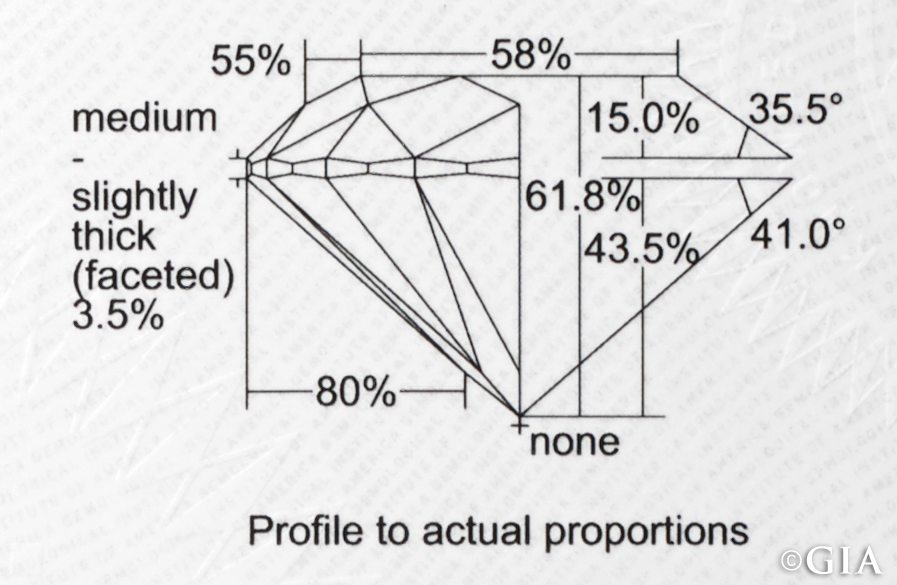
What Is Diamond Depth?
Diamond depth is the vertical distance from the table at the top of the diamond to the culet at the bottom.
Think of the diamond from the side.
You have:
- The crown above the girdle
- The girdle around the widest point
- The pavilion extending beneath the girdle
- The culet at the bottom
The total distance from the table to the bottom of the diamond is its depth.
Diamond reports generally show this measurement in millimeters and also express it as a percentage.
For a round brilliant, depth percentage is calculated relative to the diamond’s average diameter.
That percentage helps you understand how tall or deep the diamond is compared with its width.
What Does Depth Percentage Mean?
A diamond’s depth percentage tells you how much vertical depth it has relative to its face-up width.
For example, imagine a round diamond with:
- Average diameter: 6.50 mm
- Total depth: 4.00 mm
Its depth percentage would be approximately:
4.00 ÷ 6.50 × 100 = 61.5%
That does not mean 61.5% of the diamond is hidden.
It is simply a proportional measurement.
The number becomes useful because you can compare diamonds of similar shape and size.
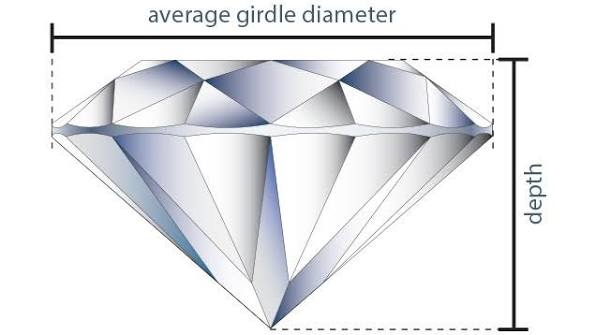
A round brilliant with a depth around 61% may distribute its weight very differently from one measuring 64%.
The deeper stone may contain more diamond material beneath the girdle without giving you a corresponding increase in visible diameter.
What Is Face-Up Size?
Face-up size is how large the diamond looks when viewed from above.
For a round diamond, this is primarily related to its diameter.
A round diamond measuring:
6.50 × 6.47 mm
will look noticeably larger than one measuring:
6.20 × 6.17 mm
even if both happen to weigh exactly 1.00 carat.
For fancy shapes, face-up size depends on both length and width.
For example:
Oval A: 9.0 × 6.3 mm
will cover more finger area than:
Oval B: 8.5 × 6.1 mm
provided the outline and proportions remain attractive.
This is why I always recommend checking actual millimeter dimensions alongside carat weight.
My diamond carat guide explains why carat should be treated as a measure of weight, not visible size.
Why Can Two 1 Carat Diamonds Look Different Sizes?
Because a cutter can distribute the same amount of diamond material in different ways.
Imagine two hypothetical 1 carat round diamonds.
Diamond A
- 1.00 carat
- 6.50 mm diameter
- Approximately 61% depth
Diamond B
- 1.00 carat
- 6.20 mm diameter
- Approximately 64% depth
Both weigh one carat.
But Diamond B carries more of its weight vertically.
Diamond A spreads more of that weight across the visible face of the stone.
The diameter difference is only 0.30 mm, which sounds small.
But because area increases across both dimensions, the difference in visible surface area can approach roughly 10%.
That is noticeable.
This is one reason a well-proportioned diamond can sometimes look larger than a heavier stone with poor weight distribution.
What Is a Too-Deep Diamond?
A too-deep diamond has an excessive amount of its weight distributed vertically rather than across its visible face-up dimensions.
This can happen through:
- Excessive pavilion depth
- A very thick girdle
- Excessive crown height
- Poor overall proportion combinations
A deep diamond may therefore look smaller than expected for its carat weight.
But depth percentage should never be interpreted in isolation.
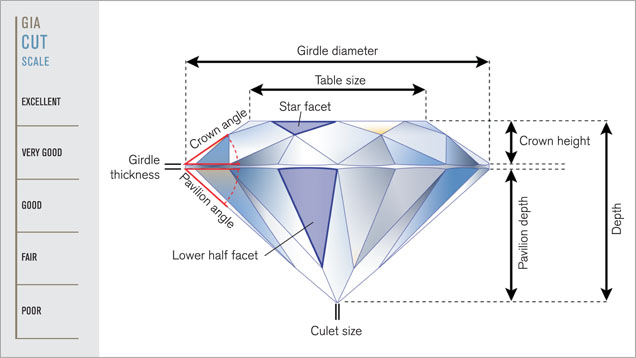
A 62% diamond is not automatically excellent.
A 63% diamond is not automatically poor.
You still need to examine:
- Table percentage
- Crown angle
- Pavilion angle
- Girdle thickness
- Diameter
- Symmetry
- Light performance
Diamond proportions work together.
Why Would a Diamond Cutter Leave a Diamond Too Deep?
Diamond cutting involves balancing beauty with weight retention.
Diamond rough is valuable.
Removing material improves proportions in some cases, but it also reduces finished carat weight.
That creates an economic incentive to preserve weight.
Imagine a cutter has a rough diamond that could produce:
0.97 carats with excellent weight distribution
or:
1.01 carats with more depth
The 1.01 carat stone crosses the psychologically important 1 carat threshold.
That can increase its market value.
From a commercial perspective, retaining that extra weight may therefore be tempting.
For the consumer, however, you may end up paying the premium associated with "1 carat" while receiving a diamond that visually resembles a smaller stone.
This is sometimes called hidden weight.
Hidden Weight: The Carat You Pay for but Cannot See
Hidden weight is one of the most useful ways to understand excessive depth.
A diamond may contain additional material:
- In the pavilion
- In an overly thick girdle
- In unnecessary vertical depth
That material contributes to carat weight.
But from above, you cannot see it as additional spread.
Suppose you are comparing:
1.05 ct Diamond A, 6.55 mm diameter
with:
1.10 ct Diamond B, 6.35 mm diameter
Diamond B weighs more.
But Diamond A may actually look larger from above.
If Diamond B also costs more because it weighs 1.10 carats, you could effectively be paying extra money for diamond material hidden underneath the stone.
That is why I always look at the millimeter measurements.
Where I Recommend Comparing Diamond Proportions
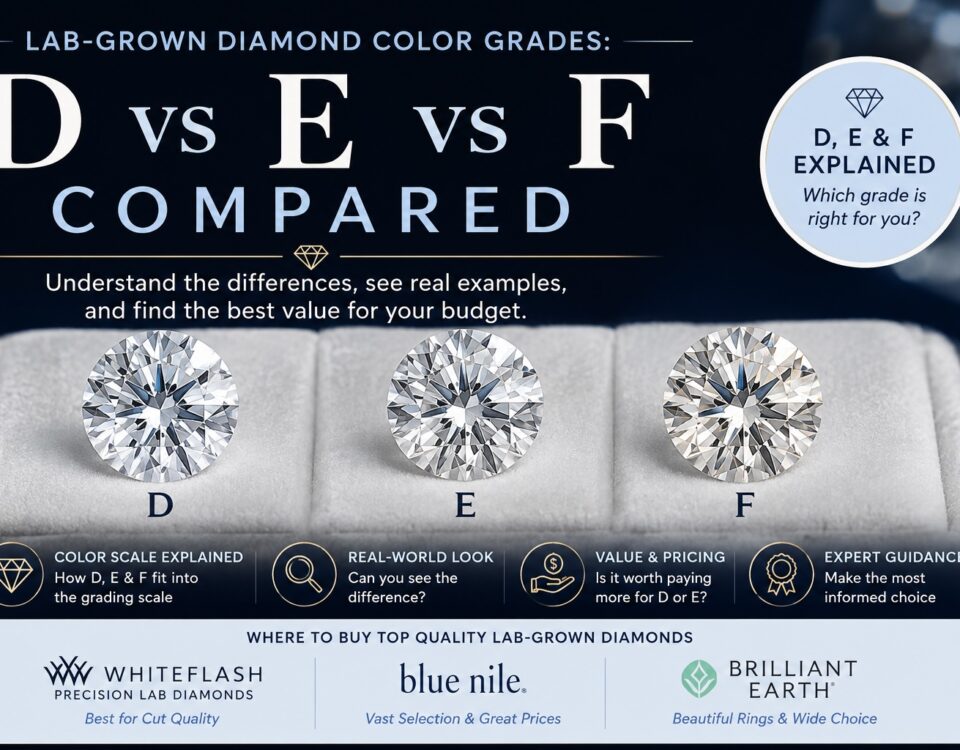
For buyers prioritizing cut quality and detailed proportion analysis, I would start with Whiteflash. Its A CUT ABOVE® and other in-house diamonds provide particularly detailed information for assessing proportions and actual light performance. Read my full Whiteflash review.
Blue Nile has a much larger inventory and can be useful for comparing diamonds around the same carat weight to see how their millimeter dimensions and depth percentages differ. Read my Blue Nile review.
Brilliant Earth is another option if you want a broad selection of natural and lab-grown diamonds across different shapes and carat weights. Read my Brilliant Earth review.
Do not compare diamonds by carat weight alone. Check the actual dimensions, depth percentage, proportions, and visual performance.
What Is a Good Depth Percentage for a Round Diamond?
For round brilliant diamonds, I generally use approximately:
59% to 62.5%
as a sensible initial screening range.
The Diamond Genie’s existing ideal diamond proportions guide uses the same general range as a starting point for balancing brilliance and spread. The Diamond Genie
However, I would not select a diamond solely because its depth falls inside that range.
Depth interacts strongly with the crown and pavilion.
A round brilliant might have:
61.8% depth
and still perform poorly if its crown and pavilion angles are badly paired.
Another diamond could fall near the edge of a preferred depth range and still look excellent because the complete proportion set works together.
For rounds, I would consider:
- Depth percentage
- Table percentage
- Crown angle
- Pavilion angle
- Lower-half facets
- Star facets
- Girdle
- Symmetry
- Actual light-performance imagery
The numbers are filters.
The finished diamond is what matters.
Is 63% Depth Too Deep for a Round Diamond?
It can be.
Once a standard round brilliant begins moving significantly above the low 62% range, I start looking more carefully at weight distribution and diameter.
At approximately 63% or more, ask:
Is this diamond facing up smaller than comparable stones?
That is more useful than applying an automatic rejection rule.
If two 1.00 carat diamonds are available and one has:
- Better diameter
- Better light performance
- Better proportions
- Lower or similar price
there is little reason to accept unnecessary depth.
But a single number should not determine the decision.
I would rather evaluate the full stone than reject an otherwise excellent diamond because its depth is a fraction outside a preferred screening range.
Is 64% Depth Too Deep?
For a conventional round brilliant, 64% would usually concern me.
At this point, a meaningful amount of weight can be carried vertically.
I would expect to investigate:
- Smaller-than-normal diameter
- Steep crown or pavilion combinations
- Thick girdle
- Light leakage
- Poor weight ratio
There may be unusual designs where deeper proportions are intentional, but for a standard round brilliant engagement-ring diamond I would normally find better alternatives.
Remember that round diamonds are abundant.
You do not need to make unnecessary compromises.
Can a Diamond Be Too Shallow?
Yes.
This is the other side of the problem.
If deep diamonds hide weight, it might seem logical to buy the shallowest diamond possible to maximize diameter.
That is not how good diamond buying works.
A very shallow diamond may spread widely, but poor pavilion geometry can allow light to escape rather than returning it through the crown.
The stone might look:
- Watery
- Flat
- Glassy
- Dark in certain areas
- Less brilliant
A larger-looking diamond is not automatically a better-looking diamond.
I want efficient spread, not maximum spread at any cost.
This is why cut quality must remain the priority.
Read my full diamond cut guide before optimizing purely for face-up size.
Why Depth Percentage Affects Light Performance
A diamond works through a complex relationship between its facets.
Light enters through the crown, interacts with pavilion facets, and is redirected back toward the observer.
If the pavilion is proportioned poorly, light may escape rather than returning efficiently.
A diamond that is too deep can therefore experience light leakage.
But there is an important nuance.
Total depth percentage does not directly determine light performance by itself.
Two diamonds with the same total depth can have different:
- Crown heights
- Pavilion depths
- Girdle thicknesses
- Angles
and therefore behave differently.
Think of depth percentage as a useful summary number.
It tells you something important.
It does not tell you everything.
Pavilion Angle Matters More Than Many Buyers Realize
The pavilion is the lower portion of the diamond beneath the girdle.
In a round brilliant, pavilion geometry has an enormous effect on the way light travels through the stone.
If the pavilion angle becomes too steep, the diamond can lose light.
If it becomes too shallow, undesirable leakage can also occur.
This means two diamonds with identical overall depth percentages can perform differently because the depth has been distributed differently.
For example, one diamond might have:
- Moderate crown
- Appropriate pavilion
- Medium girdle
while another has:
- Shallow crown
- Steep pavilion
- Thick girdle
Both could potentially arrive at a similar total depth percentage.
That is why buying a round diamond from depth alone is a bad strategy.
A Thick Girdle Can Hide Weight Too
Excessive depth is not always caused by the pavilion.
The girdle can also hide carat weight.
The girdle is the thin outer edge separating the crown from the pavilion.
You can learn more in my diamond girdle guide.
Some girdle thickness is necessary for durability.
A dangerously thin girdle can be vulnerable to damage.
But an unnecessarily thick girdle adds weight without improving visible face-up size.
That can create a frustrating combination:
higher carat weight + smaller diameter
without a corresponding improvement in appearance.
Again, this is why you need to evaluate the complete set of proportions.
Carat Weight vs. Face-Up Size
Carat measures weight.
One carat equals 0.20 grams.
It does not directly measure:
- Diameter
- Length
- Width
- Surface area
This distinction is fundamental.
Consumers naturally use carat as shorthand for size because, broadly speaking, heavier diamonds tend to be larger.
But the relationship is not exact.
Cut two diamonds from different rough crystals and distribute their weight differently, and they can produce noticeably different visible dimensions.
That means your comparison should be:
carat + millimeters
not:
carat alone.
My diamond carat guide covers this in more detail.
Why Millimeter Measurements Matter
Diamond grading reports list physical measurements.
For a round diamond, you may see something like:
6.48 × 6.52 × 3.98 mm
The first two numbers describe diameter.
The third describes depth.
That information is incredibly useful.
If another 1 carat round measures:
6.20 × 6.24 × 4.00 mm
you can immediately see that a lot more weight is concentrated vertically.
Despite having similar physical depth in millimeters, it has considerably less diameter.
From above, the first diamond will appear larger.
This can be more useful to a consumer than staring at carat weight in isolation.
What Is a Good Face-Up Size for a 1 Carat Round Diamond?
There is some natural variation, but a well-proportioned 1 carat round brilliant will typically measure somewhere around the mid-6 mm range.
Approximately 6.4 to 6.5 mm is a useful general reference point.
Do not turn that into a rigid rule.
Diamond weight, girdle thickness, and individual cutting decisions create variation.
But if you find a 1.00 carat round measuring only around 6.1 or 6.2 mm, I would immediately investigate where the weight is hiding.
Likewise, an unusually large diameter is not automatically good.
If a 1 carat diamond has been spread extremely shallow to create a large diameter, you need to make sure light performance has not been sacrificed.
Should You Buy a 0.90 Carat Diamond That Faces Up Like a 1 Carat?
Potentially, yes.
This can be an excellent value strategy.
A well-cut diamond just below a major carat threshold may have surprisingly similar face-up dimensions to a poorly spread heavier stone.
For example, imagine:
Diamond A
- 0.94 carat
- 6.35 mm
- Excellent proportions
Diamond B
- 1.00 carat
- 6.25 mm
- Excessively deep
Diamond A could actually look larger.
Yet Diamond B may carry a pricing premium simply because its certificate says 1.00 carat.
This is why I recommend looking around:
- 0.90 to 0.99 ct
- 1.40 to 1.49 ct
- 1.80 to 1.99 ct
when trying to maximize value.
My guide to 1.80 vs. 2 carat diamonds explores the same principle around the 2 carat milestone.
Depth Percentage and 2 Carat Diamonds
Depth becomes especially important as carat weight increases.
A poorly spread 0.50 carat diamond may lose a relatively small amount of visible diameter.
At 2, 3, or 4 carats, inefficient weight distribution becomes far more expensive.
Imagine paying the premium for a 2.00 carat diamond only to find that its diameter is closer to what you would expect from a well-cut 1.80 or 1.90 carat stone.
That is poor value.
At larger carat weights I pay particularly close attention to:
- Measurements
- Weight ratio
- Depth
- Girdle
- Light performance
The more expensive the diamond, the less reason there is to accept hidden weight.
Does Depth Percentage Matter for Oval Diamonds?
Yes, but it is less useful as a standalone quality indicator.
Oval diamonds do not have the same standardized cut-grading framework as round brilliants.
Two ovals with the same depth percentage can have dramatically different:
- Outlines
- Length-to-width ratios
- Bow ties
- Facet patterns
- Face-up sizes
With oval diamonds, I prioritize:
- Attractive outline
- Good face-up dimensions
- Pleasing length-to-width ratio
- Controlled bow tie
- Strong light performance
- Sensible depth
Depth is still useful as a warning sign.
An unusually deep oval may hide unnecessary weight.
But I would never choose between two ovals solely because one has a lower depth percentage.
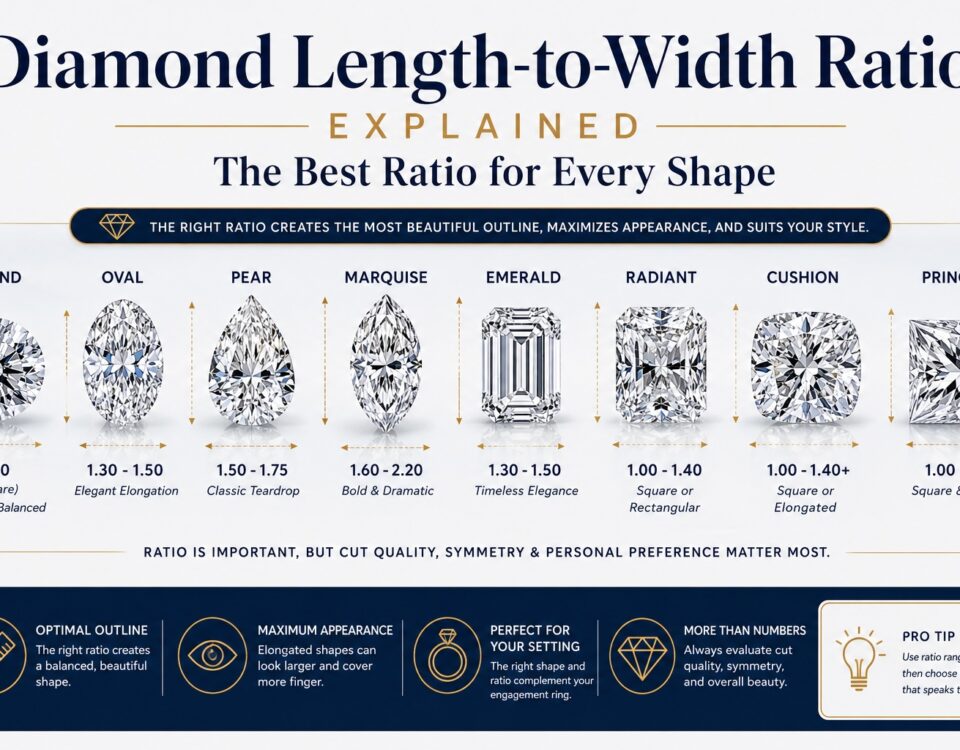
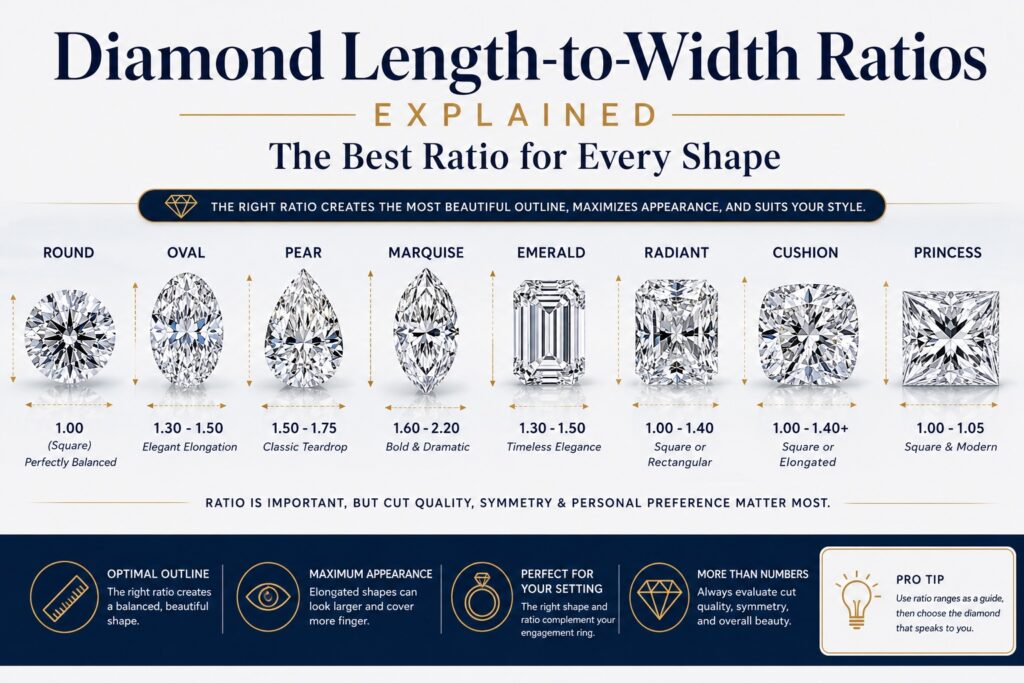
Read my diamond length-to-width ratio guide before comparing elongated shapes.
Depth Percentage in Pear and Marquise Diamonds
The same general principle applies to pears and marquises.
These shapes naturally provide excellent finger coverage because they are elongated.
That can make them look larger than many other diamonds of similar weight.
But excessive depth can still reduce spread.
For pear and marquise diamonds, examine:
- Length
- Width
- Length-to-width ratio
- Outline
- Symmetry
- Bow tie
- Depth
- Girdle
- Tip protection
A smaller depth percentage does not automatically mean a better pear or marquise.
The shape must still look balanced and perform well optically.
Depth Percentage in Emerald-Cut Diamonds
Emerald cuts require particular care because their step-cut facet structure behaves very differently from a round brilliant.
Depth affects:
- Face-up spread
- Pavilion arrangement
- Optical pattern
- Windowing
An emerald cut can be too deep and carry excessive weight below the girdle.
But chasing an extremely shallow emerald purely for spread can also create problems.
An overly shallow step cut can show windowing, where you can effectively see through portions of the diamond rather than receiving attractive reflections.
That is why emerald cuts need visual assessment.
I would compare:
- Actual dimensions
- Length-to-width ratio
- Depth
- Table
- Step pattern
- Windowing
- Extinction
- Transparency
Numbers alone cannot tell you whether an emerald cut is beautiful.
Depth Percentage in Cushion Diamonds
Cushions are one of the hardest shapes to assess using depth percentage alone.
Cushion diamonds come in many different facet structures and outlines.
You may encounter:
- Square cushions
- Elongated cushions
- Cushion brilliants
- Modified cushions
- Chunkier antique-style facet patterns
Two cushions with identical depth percentages can look completely different.
Depth is useful for identifying obvious hidden-weight problems, but I care much more about:
- Face-up dimensions
- Outline
- Facet pattern
- Light performance
- Overall appearance
Cushions often face up smaller for their carat weight than elongated shapes such as ovals or marquises.
That makes actual millimeter measurements especially important.
Depth Percentage in Radiant Diamonds
Radiants combine a rectangular or square outline with brilliant-style faceting.
As with cushions, there is considerable variation.
A deep radiant may hide weight.
But the depth percentage alone cannot tell you whether the stone has:
- Attractive scintillation
- Excessive darkness
- Crushed-ice appearance
- Balanced length-to-width ratio
Always inspect the actual stone.
My length-to-width ratio guide provides useful starting points for square and rectangular radiants.
Compare More Than Carat Weight
My first choice for buyers who want extensive cut and light-performance information is Whiteflash. The detailed measurements and imaging available for its in-house diamonds make it easier to assess whether you are paying for useful face-up size or hidden weight. Read my Whiteflash review.
If you want to compare a much larger number of diamonds, Blue Nile can be useful for examining how diamonds at the same carat weight differ in dimensions and proportions. Read my Blue Nile review.
Brilliant Earth is another option for comparing natural and lab-grown diamonds across a wide range of shapes and sizes. Read my Brilliant Earth review.
The number on the scale matters, but how efficiently the diamond uses that weight matters more visually.
Does a Bigger Face-Up Diamond Always Look Better?
No.
Face-up spread is valuable, but it is only one component of beauty.
Suppose you have two 1 carat rounds.
Diamond A
- 6.55 mm diameter
- Weak light return
- Poor contrast pattern
- Shallow proportions
Diamond B
- 6.45 mm diameter
- Excellent light return
- Strong contrast
- Beautiful scintillation
I would choose Diamond B.
That extra tenth of a millimeter is not worth sacrificing diamond performance.
A bright, lively diamond can often appear more impressive than a slightly wider but lifeless stone.
This is also why cut quality can influence perceived size.
Strong edge-to-edge brightness can make the entire diameter visually active.
Poor light return can create dark or weak areas that make the stone look less impressive.
Face-Up Size and Light Performance Work Together
Face-up size is not purely geometric.
Our eyes perceive bright objects differently from dark ones.
A diamond with strong edge-to-edge light return can look crisp and expansive.
A poorly cut diamond may have:
- Dark central areas
- Pale leakage
- Weak edges
Even if its measured diameter is slightly larger, it may not deliver the same visual presence.
This is where light-performance imagery becomes useful.
My diamond light-performance imaging guide explains tools such as:
- Ideal Scope
- ASET
- Hearts and Arrows imagery
These can help identify whether the diamond is actually returning light efficiently rather than relying solely on proportions.
Why GIA or IGI Cut Grades Are Not the Whole Story
A laboratory grading report gives you essential information.
But even within high cut grades, there can be variation.
Two round diamonds can both receive strong laboratory grades while having different:
- Proportion combinations
- Optical symmetry
- Light leakage
- Face-up spread
That is why I do not stop at the words:
Excellent
or:
Ideal.
I also examine:
- Measurements
- Crown angle
- Pavilion angle
- Depth
- Table
- Girdle
- Video
- Light-performance imagery where available
A grading report is a starting point.
It is not a photograph of beauty.
Is the Deepest Part of the Diamond Always the Pavilion?
Most of the diamond beneath the girdle is the pavilion, so pavilion depth makes a large contribution to total depth.
However, total depth includes the complete height from table to culet.
That means:
- Crown height
- Girdle thickness
- Pavilion depth
all contribute.
This is why simply saying:
"This diamond is deep because the pavilion is too deep"
may not always be correct.
Look at the complete proportion set.
Can an Extremely Thick Girdle Make a Diamond Look Smaller?
Yes.
This is classic hidden weight.
A thick girdle contains additional diamond material around the perimeter.
That increases carat weight.
But much of that additional mass does not increase the diameter in a useful way.
The result can be a heavier stone that does not face up as large as you would expect.
A slightly thick girdle can be perfectly acceptable.
I become concerned when the thickness becomes excessive and begins materially affecting weight ratio.
For more detail, read my diamond girdle guide.
Can a High Crown Make a Diamond Too Deep?
A high crown adds depth.
That is not automatically a problem.
Crown height and crown angle influence the balance between brilliance and fire.
The issue is whether the crown works with:
- Pavilion angle
- Table size
- Girdle
- Overall depth
A relatively high crown can be part of an attractive proportion set.
The mistake is treating every source of additional depth as wasted weight.
Diamond cutting is about relationships.
Does Setting Style Change Face-Up Size?
Yes, visually.
It does not alter the diamond's actual dimensions, but the setting can change how large the stone appears.
For example:
Halo Settings
A halo surrounds the center diamond with smaller stones and can dramatically increase overall visual coverage.
Thin Bands
A narrow band can create stronger contrast and make the center diamond look proportionally larger.
Bezel Settings
A bezel can increase the visual outline around the stone, although the metal also covers part of the diamond's edge.
Solitaire Settings
A minimalist solitaire keeps attention concentrated on the center diamond.
But remember:
The setting cannot recover hidden diamond weight.
If your 1 carat diamond faces up small because it is excessively deep, changing the setting does not suddenly create the missing diameter.
Does Diamond Shape Affect Face-Up Size?
Very much.
Different shapes distribute weight differently.
Elongated shapes can provide considerably more apparent finger coverage than compact shapes.
For example:
- Marquise
- Oval
- Pear
often look large for their carat weight.
Cushions and Asschers can sometimes look smaller because more weight is carried in depth or because of their geometry.
That does not make one shape better.
It simply means that:
1 carat does not translate into one universal visual size across diamond shapes.
My diamond length-to-width ratio guide goes into this in much greater detail.
Natural vs. Lab-Grown Diamonds: Does Depth Work Differently?
No.
Depth percentage and face-up dimensions work the same way whether the diamond is natural or lab-grown.
A 2 carat lab-grown diamond that is excessively deep can look smaller than a well-proportioned 2 carat natural diamond.
And vice versa.
The physics of the finished diamond does not change because of its origin.
The difference is economic.
Lab-grown diamonds have made larger carat weights much more accessible.
That means shoppers can become tempted to focus almost entirely on:
3 carats
or:
4 carats
while overlooking proportions.
Do not do that.
A large lab-grown diamond with poor spread and mediocre cut is still poorly selected.
Why Depth Matters More as Lab-Grown Diamonds Get Larger
Lab-grown diamond pricing has dramatically expanded access to large center stones.
That can encourage a mindset of:
Why buy 2 carats when I can afford 3?
But once size becomes affordable, cut selection becomes even more important.
A 3 carat diamond is visually substantial.
Any issues with:
- Excessive depth
- Poor outline
- Weak light return
- Gray or brown nuance
- Transparency
also become easier to see.
I would rather own a beautifully proportioned 2.5 carat diamond than chase 3 carats simply because the number looks better on the certificate.
Can You Judge Depth From a Diamond Video?
Sometimes you can identify poor spread from the dimensions, but a video is more useful for evaluating the consequences of the proportions.
Look for:
- Strong brightness
- Balanced contrast
- Attractive scintillation
- Edge-to-edge light return
- No obvious dead zones
Then compare the measurements against diamonds of similar weight.
If one 1.50 carat stone looks visually excellent and has noticeably larger dimensions than another, that is useful information.
Do not rely on the video alone for physical size.
Use the millimeter measurements.
Should You Always Choose the Diamond With the Largest Diameter?
No.
This would simply replace one bad shortcut with another.
Imagine three 1 carat rounds:
Diamond A
6.60 mm, too shallow, poor light performance.
Diamond B
6.48 mm, excellent proportions and strong light return.
Diamond C
6.20 mm, excessively deep.
I would probably investigate Diamond B first.
Diamond A chases spread too aggressively.
Diamond C wastes weight vertically.
Diamond B provides the balance.
That is the entire objective.
My Diamond Depth Buying Checklist
When comparing diamonds, I would work through these points.
1. Start With Carat Weight
Set the approximate size and budget you want.
2. Check Millimeter Dimensions
Do not assume the weight tells you how large the stone looks.
3. Check Depth Percentage
Use it to identify diamonds that may be too deep or too shallow.
4. Look at the Girdle
Make sure excessive weight is not being hidden around the perimeter.
5. Review the Complete Proportions
For round diamonds, look at:
- Table
- Crown angle
- Pavilion angle
- Depth
- Girdle
6. Inspect the Diamond
Video and imaging matter.
7. Review Light Performance
Where available, use analytical imagery rather than relying purely on the grading report.
Read my diamond imaging guide.
8. Compare Similar Diamonds
Compare several stones at the same carat weight.
One may immediately stand out as having more efficient dimensions.
9. Do Not Chase Spread Alone
Shallower does not automatically mean better.
10. Buy the Complete Diamond
The goal is not the lowest depth or largest diameter.
It is the best combination of beauty, size, and value.
When I Would Reject a Diamond for Being Too Deep
I would normally move on when:
- The diamond faces up noticeably small for its carat weight
- Depth is clearly outside sensible proportions
- The girdle is unnecessarily thick
- Light-performance imagery shows significant leakage
- Comparable diamonds provide larger dimensions and better performance
- I am effectively paying for hidden carat weight
The availability of diamonds online means there is rarely a reason to force a poor option to work.
When a Slightly Deeper Diamond Might Still Be Worth Buying
I would not reject a diamond simply because it is a fraction deeper than my preferred range.
I would still consider it if:
- The face-up dimensions are good
- Light performance is excellent
- The crown and pavilion work well together
- The girdle is appropriate
- The stone looks beautiful
- The price is competitive
Diamond buying should not become a spreadsheet exercise.
Proportion filters are designed to help you find beautiful diamonds.
They are not a substitute for evaluating them.
Frequently Asked Questions About Diamond Depth
Can a diamond be too deep?
Yes.
An excessively deep diamond can hide carat weight beneath the girdle and face up smaller than a better-proportioned stone of the same weight.
Does a deep diamond look smaller?
Often, yes.
If more weight is carried vertically, less of it contributes to visible diameter or surface area.
What is a good depth percentage for a round diamond?
Approximately 59% to 62.5% is a useful starting range, but the complete proportion set must be evaluated.
Is 63% diamond depth too much?
It can be.
I would check the diamond's diameter, girdle, crown and pavilion angles, and light performance before deciding.
Is 64% too deep for a round diamond?
For a conventional round brilliant, I would generally consider 64% unusually deep and would investigate why the stone carries that much vertical weight.
Is a shallow diamond better?
Not necessarily.
An overly shallow diamond may spread larger but sacrifice light performance.
Does carat weight tell you diamond size?
Only partially.
Carat measures weight, not visible dimensions.
Always check the millimeter measurements.
Can a 0.90 carat diamond look bigger than a 1 carat?
Yes.
A well-proportioned 0.90 to 0.99 carat diamond can have a larger face-up diameter than an excessively deep 1.00 carat stone.
Does a thick girdle hide carat weight?
It can.
An excessively thick girdle adds diamond material without necessarily improving face-up size.
Does depth affect sparkle?
Depth contributes to the overall proportions controlling light performance, but depth percentage alone cannot predict brilliance.
Are depth rules the same for oval and round diamonds?
No.
Rounds have much more standardized proportion analysis.
Fancy shapes require greater emphasis on outline, dimensions, facet pattern, and visual assessment.
Does depth matter for lab-grown diamonds?
Yes.
The same proportion principles apply to natural and lab-grown diamonds.
Should I choose the widest diamond at a given carat weight?
Not automatically.
Maximizing diameter at the expense of cut quality can leave you with a larger but less beautiful stone.
Final Verdict: Can a Diamond Be Too Deep?
Absolutely.
A diamond can contain the correct carat weight but distribute too much of that weight vertically.
That means you may pay for:
1.00 carat
while receiving the visible size you might expect from a lighter, better-proportioned diamond.
Excessive depth can also be associated with proportion combinations that reduce light performance.
But the solution is not to buy the shallowest diamond possible.
A shallow diamond can sacrifice brilliance in pursuit of spread.
Instead, look for balance.
For round brilliants, approximately 59% to 62.5% depth provides a useful starting point, but always examine the crown angle, pavilion angle, table, girdle, diameter, and actual light performance as well.
For fancy shapes such as oval, pear, cushion, emerald, radiant, and marquise diamonds, depth percentage is best treated as a screening tool rather than a strict quality grade.
Above all, remember:
Carat is weight. Millimeters are size. Cut determines how effectively the diamond turns that size into beauty.
Use my diamond carat guide to understand weight and visible size, my diamond cut guide to evaluate proportions, and my diamond imaging guide to assess actual light performance.
For retailer comparisons, I would begin with Whiteflash when detailed cut and light-performance information is the priority, compare the broader inventory at Blue Nile, and consider Brilliant Earth for another large selection of natural and lab-grown diamonds.
The simplest rule is:
Do not pay for carat weight you cannot see.

Jasmine, together with Benjamin (Ben), is the passionate force behind The Diamond Genie. Their journey into the world of diamonds began with their own engagement ring experience, sparking a deep fascination with gemology and the diamond trade. This personal adventure turned into a mission to empower others in their diamond buying decisions. Jasmine’s expertise, honed from extensive study and immersion in the field, drives The Diamond Genie’s commitment to helping customers find the best diamonds for the best value. With a keen eye for quality and value, and a desire to share knowledge with others who might feel overwhelmed by the diamond selection process, Jasmine has made The Diamond Genie a trusted ally for anyone navigating the complexities of diamond purchasing.